What are the operating limitations of the 133 series mini size centrifugal fans in high temperature or high humidity environments?
Operating Environment Limitations
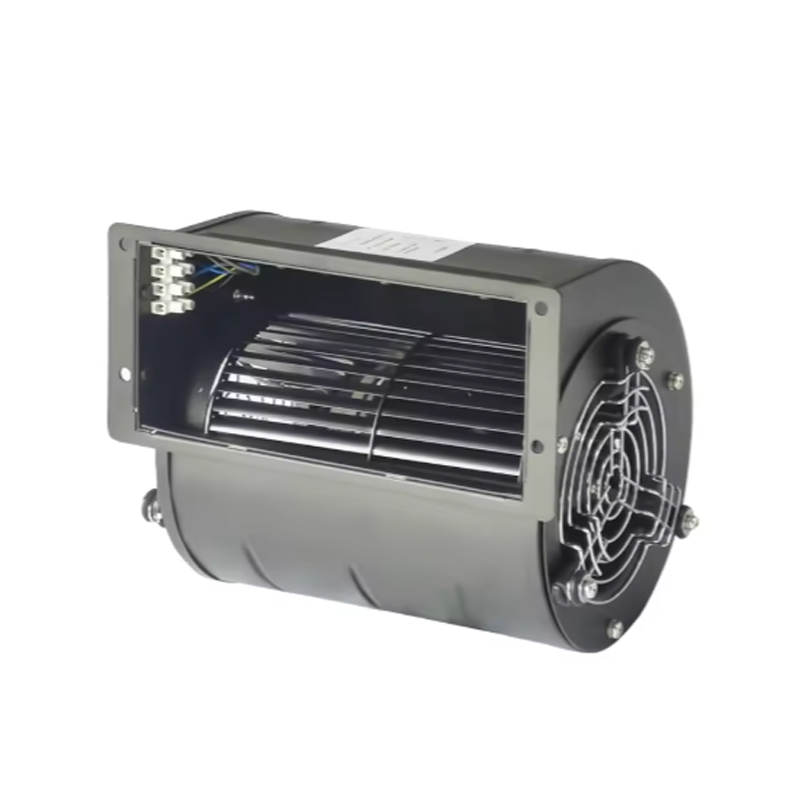
1. Temperature Range: This series of centrifugal fans uses a galvanized steel impeller and an AC external rotor motor. The insulation class is F, and it is equipped with a thermal overload protector. The operating temperature range is -30℃ to +60℃.
Exceeding this range will cause motor insulation aging and bearing lubrication failure, thus affecting the fan's lifespan.
2. Humidity Adaptability: The housing protection rating is IP42, suitable for non-condensing environments with 0%-85%RH (relative humidity).
In high humidity (>85%RH) or condensation environments, metal parts are prone to corrosion, and water may enter the motor, causing short circuits or performance degradation.
3. Precautions for High Temperature and High Humidity Combinations: When the temperature approaches the upper limit (≈60℃) and humidity is high, it is recommended to install a moisture-proof and rust-proof housing or use a stainless steel impeller to improve durability.
For long-term operation, the motor temperature sensor and protective mesh should be checked regularly to prevent increased mechanical clearance due to thermal expansion and contraction.
4. Company's Technological Advantages for Extreme Environments
Ningbo Haoyue Fan Manufacturing Co., Ltd. has many years of experience in the R&D of centrifugal fans and can provide customized motors with Class F insulation and IP42 protection, which can be upgraded to IP44 or higher protection levels according to customer needs.
The company uses galvanized steel sheet with stainless steel as an alternative in material selection to ensure stable performance in humid or corrosive environments.
| Limitation |
Details |
| Maximum Ambient Temperature |
Recommended operating range: ‑20 °C – +50 °C. Exceeding this may cause motor overheating and insulation aging, reducing lifespan and performance. |
| Maximum Relative Humidity |
Safe operation up to 90 % RH. Higher humidity can lead to condensation inside the fan, corroding the impeller and motor insulation. |
| Protection Rating |
IP44 – protects against splashing water and small droplets, but not against strong spray or immersion. |
| Reliability Recommendation |
In environments where high temperature and high humidity coincide (e.g., tropical industrial workshops), use a moisture‑ and heat‑resistant enclosure or select a model with a higher IP rating. |
What is the noise level of the 133 series mini size centrifugal fans?
Noise Level Performance
1. Standard Noise Data
The typical model SFD-KF133B24H has a noise level of 62.5 dB(A) at rated speed.
A low-noise version, the FC-133 series, has a noise level of approximately 56 dB(A) at 1800 RPM and approximately 57 dB(A) at 1250 RPM.
2. Causes of Noise Generation
The dual-inlet design ensures uniform airflow distribution at the inlets, reducing localized turbulence.
The use of a backward-curved impeller and hybrid plastic/metal blades further reduces airflow impact noise.
3. Noise Reduction Measures
Installing sound-absorbing cotton or sound insulation panels inside the casing.
Using a low-noise EC motor (such as a 24V/48V DC version) can reduce noise to below 50dB(A).
4. Noise Reduction Advantages of Haoyue Fan Manufacturing Co., Ltd.
The company provides EC brushless motors and adjustable-speed PWM control, achieving optimal matching between noise and airflow.
Through precision duct design and dual-inlet optimization, noise levels are 5-8dB lower than traditional centrifugal fans at the same airflow.
How to determine whether a frequency converter or speed control device is needed for the same airflow requirements?
| Evaluation Criterion |
Explanation |
| Air‑flow & Static‑pressure Variability |
If the system must adjust flow or pressure across different operating conditions (seasonal loads, equipment start‑stop), a VFD enables continuous speed control. |
| Energy Consumption & Operating Cost |
Variable‑speed operation reduces motor power roughly in proportion to the cube of the flow reduction, yielding significant energy savings, especially for long‑run HVAC applications. |
| Motor Compatibility |
The 133 mm series offers 0‑10 VDC/PWM control interfaces, directly compatible with VFDs or dedicated speed controllers without additional modifications. |
| Noise & Vibration Control |
Lower speeds decrease acoustic noise, improving the environment for noise‑sensitive precision instruments. |
| System Complexity & Cost |
If the fan operates at a single, constant point, a VFD may be unnecessary, simplifying the system and lowering upfront cost. |
1. Matching Airflow and Static Pressure Requirements
When the system requires variable airflow (e.g., air conditioning terminals, cabinet cooling) and static pressure varies significantly with load, variable frequency drive (VFD) is recommended.
If only a fixed airflow is required and the operating point is near the fan's optimal efficiency point (BEP), a fixed-speed motor can be used directly, saving VFD costs.
2. Energy Consumption and Operating Cost Considerations
Variable frequency drive can automatically reduce motor speed according to the actual load. Power consumption decreases with the cube of the speed, reducing energy consumption by 30%-50%.
For scenarios with long-term intermittent operation or seasonal load fluctuations, the payback period for VFD is typically within 1-2 years.
3. Control Accuracy and System Compatibility
If the system requires precise airflow control (e.g., cleanrooms, laboratories), VFD combined with a PID controller can achieve an airflow error of ±2%.
For simple ventilation (such as heat dissipation for small instruments), mechanical speed control valves or resistive speed control are sufficient.
4. Haoyue's Customized Solutions
Haoyue offers two drive methods: single-phase direct-drive AC motors and EC brushless motors, both compatible with domestic or imported VFDs.
The company has experience in integrating variable frequency speed control systems and can provide optimal VFD selection and parameter calibration based on the customer's airflow-static pressure curve.
Frequently Asked Questions (FAQ)
Q1: Does the product support customization (e.g., different voltages, speeds, or special materials)?
A: Ningbo Haoyue provides OEM customization services. We can adjust the voltage (230V/400V), speed, impeller material (carbon steel or stainless steel), and enclosure protection rating (IP54/55) according to customer needs.
Q2: What are the installation precautions for this fan?
A: The fan is compact and suitable for wall mounting or flange installation. During installation, ensure the inlet and outlet are unobstructed and maintain sufficient air intake space. Using vibration damping pads can further reduce noise and mechanical shock.
Q3: What are the key points for maintenance?
A: Regularly check the lubrication of the impeller and motor bearings, clean the air intake filter, and ensure the motor wiring is secure. A comprehensive inspection is recommended every 6 months to ensure long-term stable operation of the fan.
Q4: How is the quality management system for this product guaranteed? A: Ningbo Haoyue has passed ISO9001 quality management system certification. All fans leaving the factory undergo strict factory testing, including air volume, air pressure, noise and electrical safety tests, to ensure that the products meet international standards.

 English
 Español

 ENG
ENG
