
 English
 Español

Content
- 1 What a Radial Fan Is, and What It Is Not
- 2 How a Radial Fan Builds Pressure
- 3 Blade Geometry Decides the Duty
- 4 AC or EC Drive, Direct or Belt Drive
- 5 Construction Details That Decide Long-Term Behaviour
- 6 Sizing: Work Backwards From the Duty Point
- 7 Where Radial Fans Earn Their Place
- 8 Radial vs Axial: A Fast Comparison
- 9 What to Put on the Purchase Order
- 10 Frequently Asked Questions
A plant engineer calls on Monday morning: a ducted air handling unit is running 15% short on airflow, and the axial fan in the plenum cannot push air through a long, filter-loaded duct run. The answer is usually the same — fit a radial fan, re-check the duty point, and the airflow comes back.
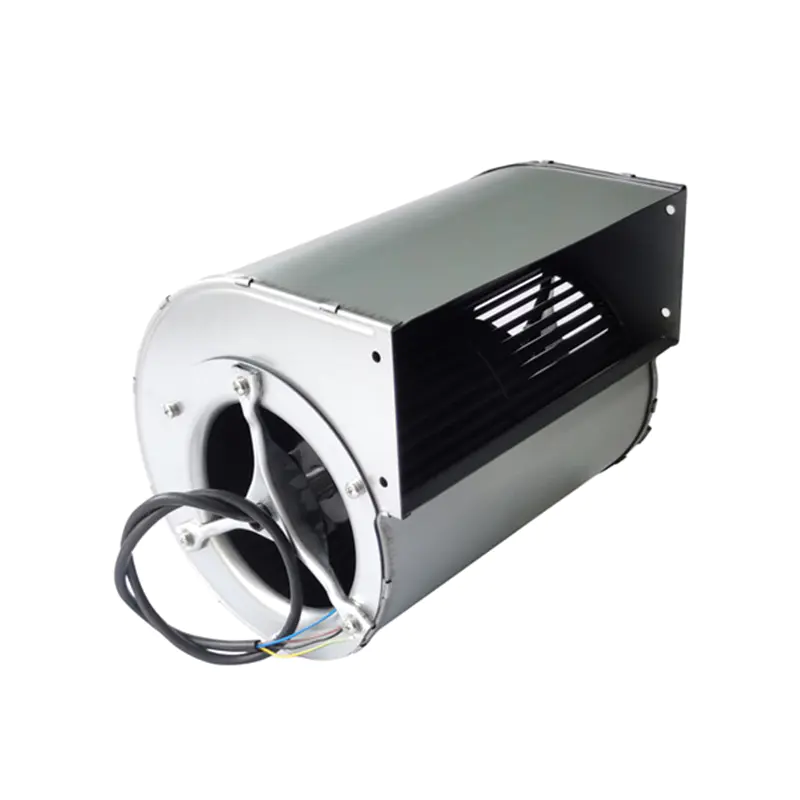
A radial fan, also called a centrifugal fan, draws air in along the motor axis and discharges it at roughly 90 degrees to the intake. That change of direction is what lets it build high static pressure, which is exactly what ducted HVAC systems, air purifiers, dehumidifiers and long air-transport runs need.
What follows is the practical part: how the airflow develops, which blade shape suits which duty, where AC and EC drives differ, and which details belong on a purchase order.
What a Radial Fan Is, and What It Is Not
Start with the decision rule. If system resistance is high or the duct run is long, choose radial. If the job is to move a large volume of air against almost no resistance — a wall opening, a cooling tower, a condenser bank — an axial fan is smaller, cheaper and easier to install.
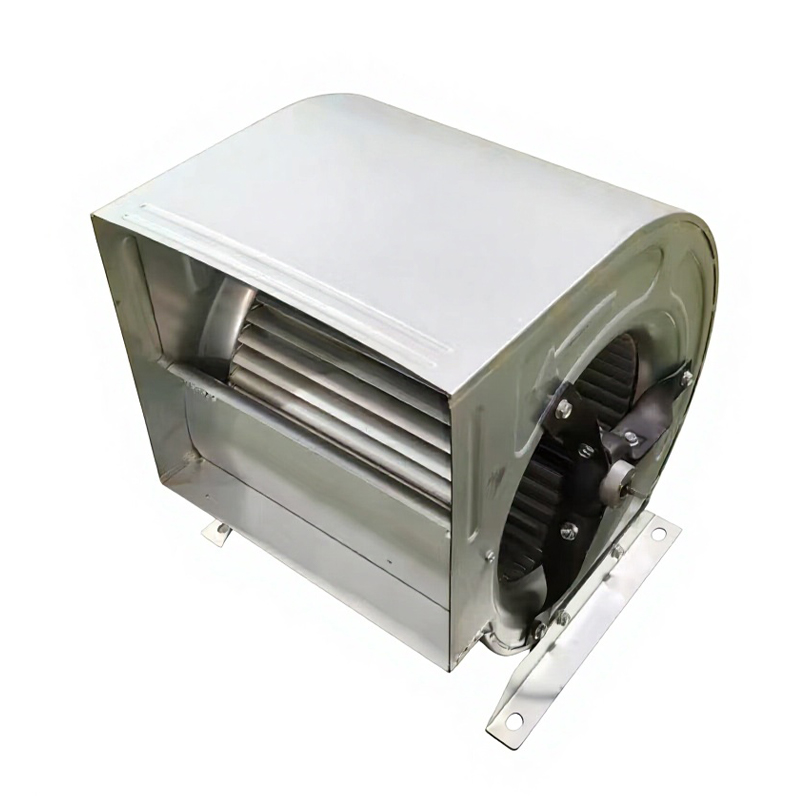
A radial fan is built around three parts: an impeller with blades arranged around one or two inlet eyes, a volute housing that wraps around the wheel, and a motor driving the wheel directly or through a belt. Air enters at the centre and is thrown outward; the housing collects that fast-moving air, slows it and converts velocity into static pressure.
- Air enters parallel to the shaft and leaves the wheel radially, at right angles to the axis.
- The outlet sits at about 90 degrees to the inlet, so the unit fits the corner of a duct layout.
- Pressure comes from centrifugal force plus the volute, not from the lifting action of an axial propeller.
One distinction is worth keeping clear in tender documents: a radial fan is not a blower in the strict sense. Blowers are usually defined by a higher pressure ratio and are used for conveying or process gas; radial fans are low-pressure air movers for ventilation, air conditioning, purification and drying.
How a Radial Fan Builds Pressure
The sequence is short, and it explains most selection mistakes:
- Air enters through the inlet cone and reaches the eye of the impeller.
- The rotating blades accelerate the air outward, adding velocity and a modest amount of static pressure.
- The volute collects the air and expands gradually, slowing it and converting velocity into static pressure.
- The air leaves through the rectangular or round outlet, still fast enough to overcome the next length of duct.
Two consequences follow. Because the wheel adds pressure by centrifugal action, a radial fan holds its flow better when resistance is added, for example when a filter loads up. And power draw behaves differently by blade type: backward-curved wheels are non-overloading, so the motor will not be overloaded if resistance drops, while forward-curved multivane wheels gain power as flow increases and need a margin on the motor rating.
Blade Geometry Decides the Duty
Before comparing model numbers, compare blade shapes — the same casing with a different wheel produces a different curve, a different sound level and a different reaction to a blocked filter.
| Blade type | Flow vs pressure | Efficiency | Behaviour when resistance falls | Typical duty |
|---|---|---|---|---|
| Forward-curved (multivane) | High flow at moderate pressure, small envelope | Lower | Power rises with flow; motor margin needed | Air handling units, fan coil units, packaged equipment |
| Backward-curved | Moderate flow, high pressure | Highest | Non-overloading | Ducted HVAC, clean-air supply, larger air movement |
| Radial (straight) blade | High pressure over a narrow flow band | Lowest of the three | Power rises with flow | Dusty or abrasive exhaust, process air |
The choice usually comes down to two questions: how much pressure the system really needs, and how much space is available. Where the envelope is tight, a multivane wheel wins on size; where running cost matters over years, a backward-curved wheel usually repays the extra first cost.
AC or EC Drive, Direct or Belt Drive
For variable-air-volume work, an EC motor with a 0-10 V control signal is normally the better answer. For fixed-speed, cost-sensitive equipment, a single-phase AC external-rotor motor remains hard to beat.
- AC external-rotor, single phase. Usually 230 V, capacitor-run, speed set by voltage tapping or an external controller. Simple wiring, low cost, few electronics to fail.
- EC (electronically commutated). Integrated electronics bring 0-10 V or PWM speed control, soft start, lower consumption at part load and a wider usable speed range — the natural choice for pressure-controlled VAV boxes.
- Direct drive. No belts, no re-tensioning, compact footprint, but the speed is fixed by the motor tap or the electronics.
- Belt drive. Flexible, since a pulley change alters the speed, and it can keep the motor out of a hot or dirty airstream, at the cost of alignment, belt wear and periodic maintenance.
If the air being moved is hot, as in a heating coil duty, decide early whether the motor sits in the airstream and specify bearings and insulation class accordingly. That decision is far cheaper at the quotation stage than after commissioning. EC centrifugal fans are the usual answer when the fan has to follow a pressure set point instead of running at one fixed speed.
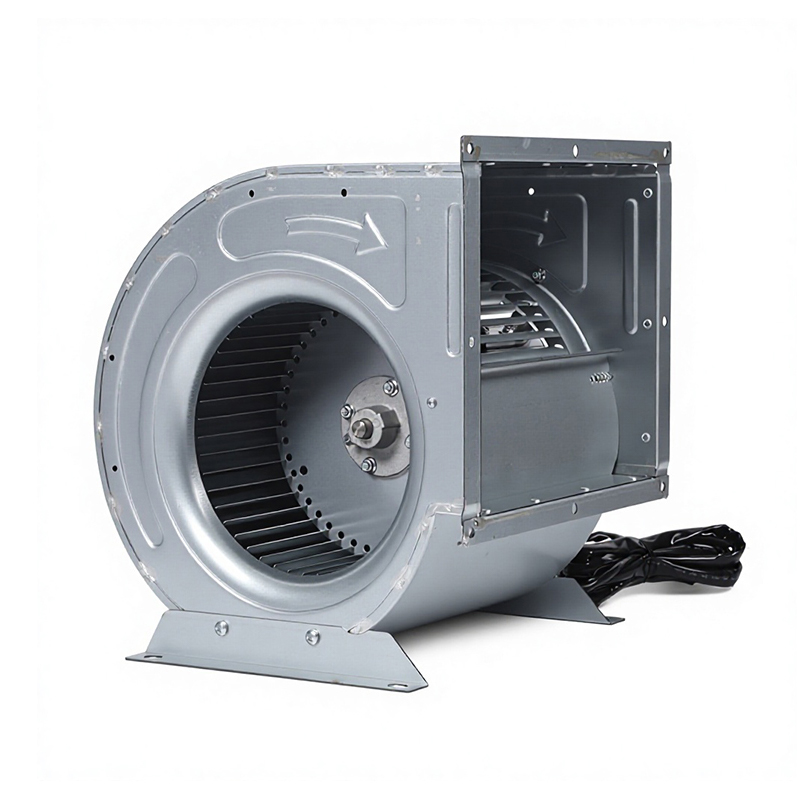 SYZ 9-9 Variable-Speed EC Centrifugal Fan for HVACAdjustable 200–1100 RPM EC centrifugal fan with direct-drive 1000 W motor, suited to HVAC ventilation where pressure set point control and energy efficiency matter.View Product →
Construction Details That Decide Long-Term Behaviour
The parts list is short, but the tolerances on that list separate a fan that runs quietly for eight years from one that is replaced in the second.
- Impeller. Galvanised SGCC sheet steel is common in ventilation and air-conditioning wheels. What matters more than the material is balance quality and how the blades are fixed, because an unbalanced wheel loads the bearing and radiates noise.
- Volute and inlet cone. Housing gauge affects rigidity, and a scroll that flexes under pressure is a noise source. The running clearance between impeller and inlet cone controls recirculation, so ask for the specified value.
- Motor. Insulation class, bearing type and rated ambient temperature belong on the data sheet, not in a footnote.
- Console, guards and terminal box. Check the mounting plane and hole pattern against your own drawing before production, not after delivery.
Impellers are also supplied on their own for equipment builders who mount the wheel in their own housing or on their own motor shaft. In that case shaft-hole size, wheel height and rotation direction must be confirmed on a drawing, because two wheels that look identical from outside can differ in all three.
 IM 160-60 SGCC Single-Inlet Blower Impeller160 mm SGCC single-inlet blower impeller with 8 mm shaft hole, for OEM builders mounting a wheel in their own housing.View Product →
Sizing: Work Backwards From the Duty Point
A radial fan is not selected by diameter. It is selected where the fan curve crosses the system curve, and everything else — motor size, speed, noise, price — follows from that point.
- Fix the airflow you actually need at the operating condition, not the figure printed on the old nameplate.
- Estimate system resistance twice: with clean filters and with dirty filters. The gap is often larger than the fan's tolerance.
- Plot both curves and confirm the crossing point sits clear of the stall region on the left and of the far right, where efficiency falls away.
- Check shaft power and motor rating at that point, including the margin the blade type requires.
- Check sound power at inlet and outlet, and confirm the envelope: orientation, mounting plane, service access and space to remove the impeller.
- Confirm the electrical supply — voltage, frequency, phase, and control signal if the motor is EC.
| Input | Why it matters | What to confirm |
|---|---|---|
| Required airflow | Sets the size class and wheel diameter | Value at real operating condition, with tolerance |
| System resistance | Determines the duty point on the curve | Clean and dirty filter cases, damper positions |
| Supply and control | Decides AC or EC and whether speed can be trimmed | 230 V single phase, 50/60 Hz, 0-10 V signal |
| Air conditions | Affects insulation, bearings and wheel material | Temperature, humidity, dust loading |
| Envelope | Decides orientation, mounting and access | Flange dimensions, rotation direction, service space |
Where Radial Fans Earn Their Place
The duties below share one feature: they need pressure, not just airflow.
- Air handling and VAV units. Blow-through or draw-through positions, with EC speed control following a duct pressure set point.
- Air purification and filtration. A loaded pleated or HEPA filter adds substantial resistance, which is where pressure capability matters.
- Dehumidifiers, dryers and heaters. Compact multivane wheels fit the casing of a packaged unit and can be driven by the unit's own motor.
- Duct boosting and air transport. Single-inlet fans with a small volute push air along long or complex runs, including high-static-pressure versions.
- Refrigeration and exhaust. Straight-blade and multivane wheels both appear here, chosen for pressure and tolerance to the airstream.
- Equipment OEM. Miniature wheels of 133 mm, 146 mm and 160 mm diameter are built into compact appliances where depth is measured in millimetres.
In equipment of that kind the fan is rarely the most expensive component, but it is often the one the customer hears. Miniature radial fans with an external-rotor motor keep the depth low while still producing the pressure a short duct or a dense filter needs.
 Hoyofan JS133A2E07-W 133–190 mm AC Centrifugal FanCompact AC external-rotor centrifugal fan, 133–190 mm, 220 V, 600–6,000 m³/h, for industrial ventilation where depth and filter resistance matter.View Product →
Radial vs Axial: A Fast Comparison
Both fans move air; the difference is how they use the space they occupy and how they behave when resistance rises.
| Parameter | Axial fan | Radial (centrifugal) fan |
|---|---|---|
| Air path | Straight through, parallel to the shaft | In at the centre, out at 90 degrees |
| Pressure capability | Low to moderate | Moderate to high |
| Flow for the same size | Higher | Lower |
| Ducted systems | Best on short, low-resistance runs | Best on long or restricted runs |
| Typical use | Roof extract, cooling towers, condensers | AHUs, VAV boxes, filtration, dryers, duct boosting |
What to Put on the Purchase Order
The purchase order decides whether the fan performs as the curve promised. A line item reading "centrifugal fan, 1 unit" leaves the supplier to choose the wheel, the speed and the motor, and the result will rarely match the system.
- Model reference and the curve revision it refers to, at the stated frequency.
- Airflow and static pressure at the duty point, with an acceptable tolerance.
- Supply details: voltage, phase, frequency, and control signal for an EC motor.
- Motor insulation class, bearing type and rated ambient temperature.
- Wheel material, for example galvanised SGCC, and the balance requirement.
- Inlet and outlet orientation, flange dimensions and mounting hole pattern.
- Rotation direction viewed from the drive end, plus drawing approval before production.
For OEM supply, ask for the drawing set and the fan curve together. A curve without dimensions can be perfect on paper and still fail to fit; dimensions without a curve leave performance to chance. The fastest route is usually to send the duty point, the available envelope and the electrical supply, then ask for a model that satisfies all three — you can send those details to the manufacturer and have wheel, speed and motor confirmed in one reply.
Frequently Asked Questions
Is a radial fan the same as a centrifugal fan?
In practice, yes. Both names describe the same machine: air enters along the axis and leaves radially. European documents tend to say radial fan, while North American documents and most fan curves say centrifugal fan.
Why does my radial fan lose airflow after a few weeks of running?
Nearly always because system resistance increased — a loaded filter, a partly closed damper, or an added duct section. Check the operating point against the curve before blaming the fan. If the motor is EC, also confirm that the control signal is actually reaching it.
Can I reduce noise by slowing the fan down?
Yes, and it is usually the most effective single change: fan noise falls sharply as speed drops, while airflow falls only in proportion. With an EC motor, trimming speed to the real duty point is straightforward; with an AC motor you may need a different voltage tap or an external controller.
How much space should be left around the fan?
Leave enough room to remove the impeller without dismantling the duct, and keep the inlet clear of obstructions that distort flow into the inlet cone. Service access is a design requirement, not a decision to be made on installation day.
Radial fans are chosen for one reason: they hold pressure where axial fans run out of it. Match the blade shape to the duty, the drive to the control strategy and the clearances to the drawing, then confirm the whole package at both clean and dirty filter conditions. Do those four things, and the fan will still be doing its job long after the handover meeting.

 ENG
