
 English
 Español

Content
- 1 Industrial Fan and Blower: One Phrase, Two Different Jobs
- 2 How a Centrifugal Blower Turns Motor Torque into Airflow
- 3 Blower Types and Where Each One Fits
- 4 Matching Airflow, Static Pressure and Motor Type to Your Application
- 5 AC or EC Motor: Where the Money Actually Goes
- 6 Blower Impellers: The Component Buyers Often Leave Blank
- 7 Procurement Checklist Before You Place an Order
- 8 FAQ
A ducted air conditioner that fails its airflow test on the assembly line usually fails for the same reason: the fan or blower was picked from a catalogue page instead of from a duty point. Two 200 mm centrifugal blowers can look identical in a photo, yet one holds its curve at 250 Pa while the other loses a third of its airflow once the filter loads up.
That is the whole argument in one line: for industrial fan and blower selection, airflow and static pressure at the real operating point decide whether a unit passes or fails. Motor type, wheel geometry and housing design matter only in how they help you reach that point.
This guide is for equipment builders who buy centrifugal fans as components rather than as finished units.
Industrial Fan and Blower: One Phrase, Two Different Jobs
A fan moves a large volume of air against low resistance. A blower raises pressure to push that air through filters, coils, long ducts or a closed system. The difference is not size or motor power; it is where the duty point sits on the pressure axis.
In HVAC equipment, most parts called blowers are centrifugal blowers, meaning a wheel inside a scroll housing. Positive displacement blowers such as lobe or screw types belong to a different family: they deliver near-constant volume whatever the resistance, and they are rarely the right answer for air handling.
Where each design sits on the pressure scale
Axial fans are flow machines. Forward-curved centrifugal wheels sit in the middle. Backward-curved wheels reach higher pressure with better efficiency.
Practical consequence: when a specification says blower without a pressure figure, ask for the duty point. A design that works at 120 Pa with a clean filter may not work at 300 Pa with a loaded one.
How a Centrifugal Blower Turns Motor Torque into Airflow
Air enters the impeller eye, is caught between the blades and thrown outward by centrifugal force. The scroll housing collects that fast-moving air and slows it down, converting velocity into static pressure. Wheel diameter, blade shape, inlet width and scroll clearance are all ways of tuning that conversion.
Single inlet and double inlet
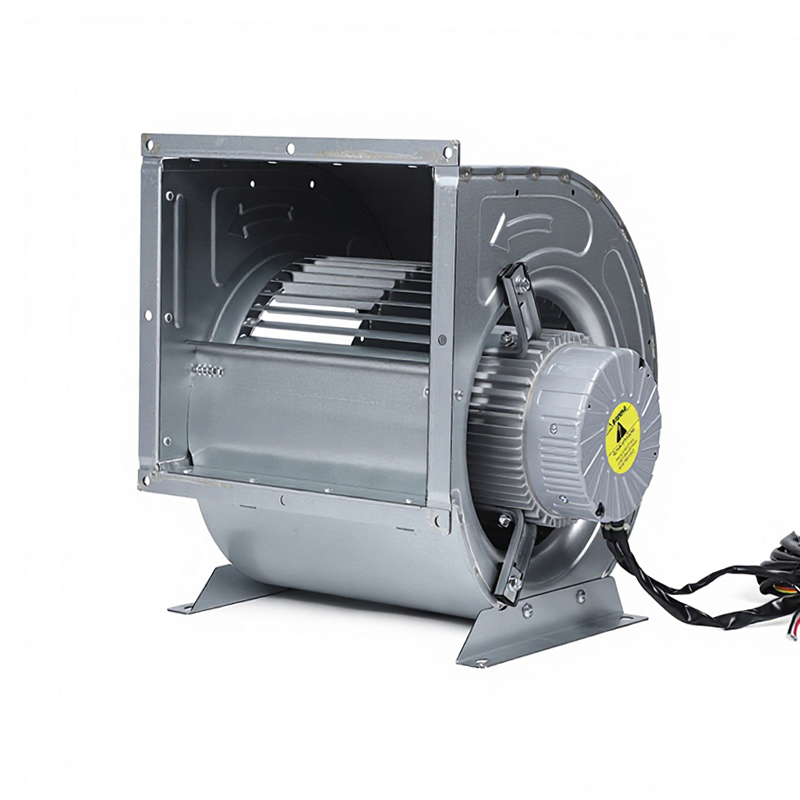
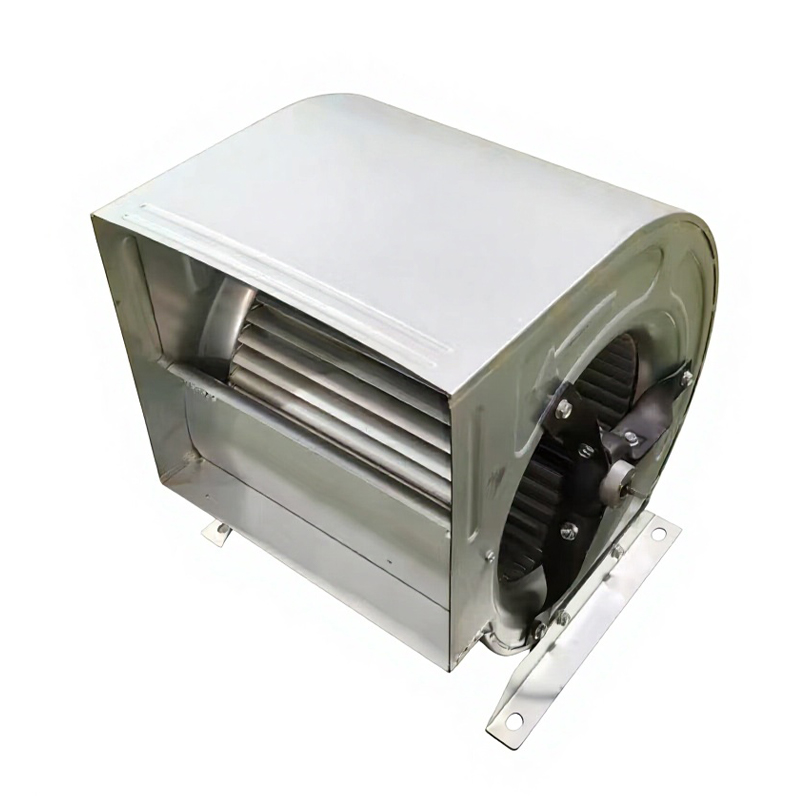
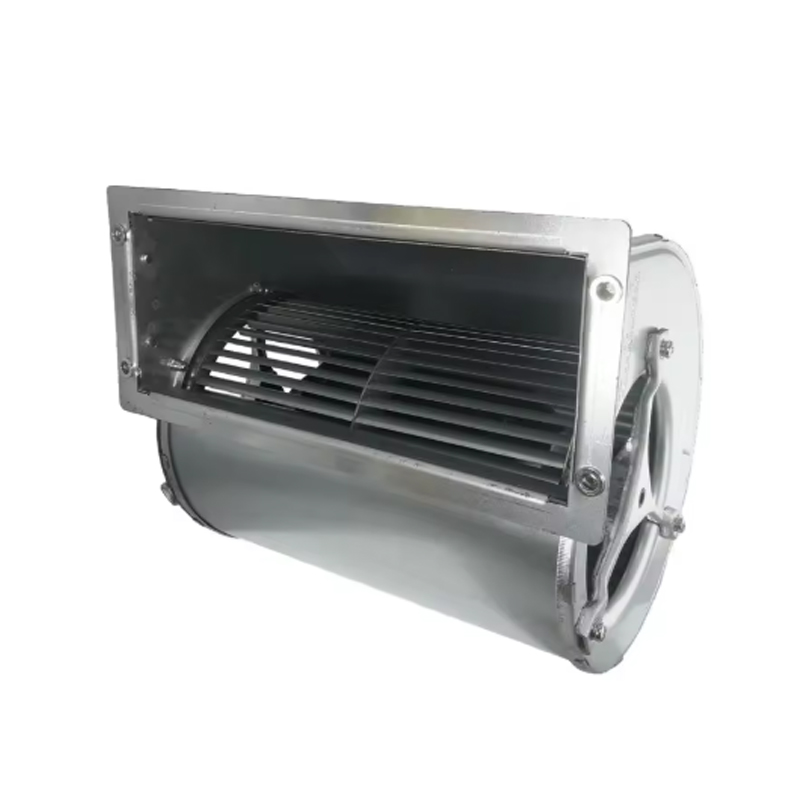
A single inlet wheel draws air from one side. It is compact and easy to duct, which is why duct-mounted single inlet centrifugal fans are common in fresh-air and air transport systems. A double inlet wheel draws from both sides of the housing, roughly doubling the inlet area for a similar footprint and lowering noise at the same airflow.
Forward-curved versus backward-curved wheels
Forward-curved wheels have many shallow blades and produce more airflow per revolution at lower pressure, which suits compact air conditioners. Backward-curved wheels have fewer, deeper blades and reach higher static pressure with better efficiency and a gentler noise profile, making them the better fit when a dense filter or a long duct sits downstream.
Blower Types and Where Each One Fits
Catalogue language varies between suppliers, but the families map onto real equipment in a consistent way.
AC centrifugal fans
Direct-drive single-phase motors, typically 150 W to 900 W in the larger frame sizes, used for air conditioner direct-drive, refrigeration ventilation and exhaust duties. Speed is set through motor taps or capacitor arrangements, so airflow is fixed during design rather than adjusted at every operating condition.
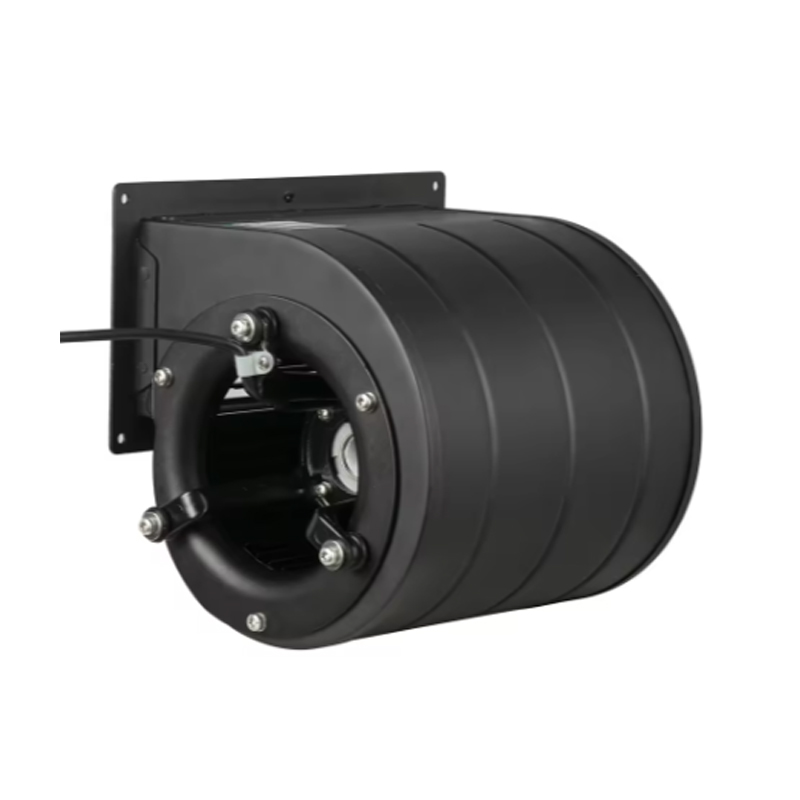
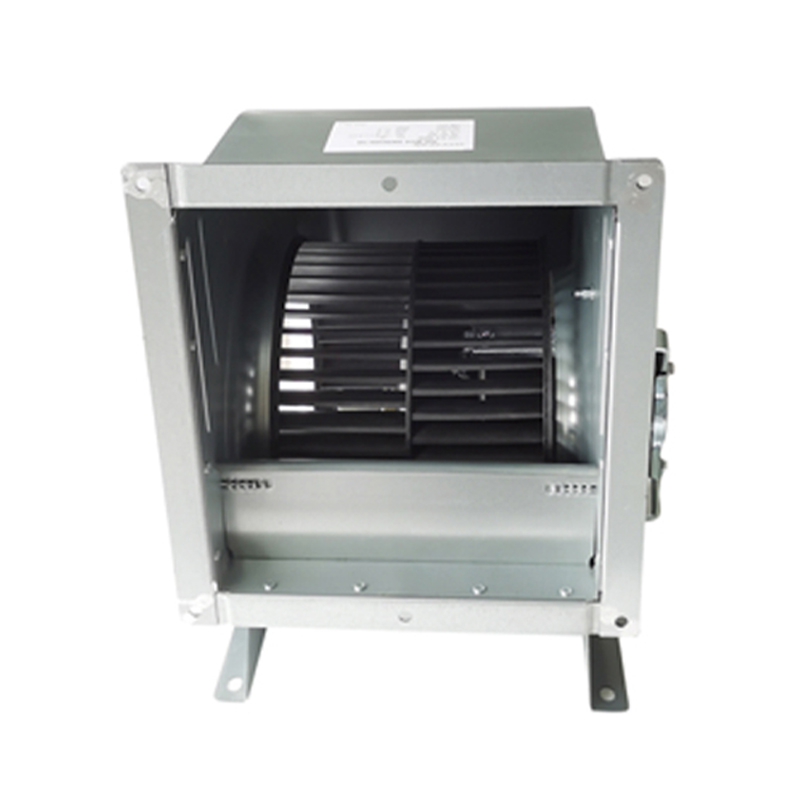 LKZ 10-8-600W Air Conditioner Direct-Drive AC Centrifugal FanFor fixed-speed AC ventilation duties, this 600 W direct-drive centrifugal fan offers IP54 aluminum housing, F insulation, and optional vertical bracket mounting.View Product →
EC centrifugal fans
Brushless DC motors with integrated electronics, usually controlled through a 0-10 V signal or PWM. They hold efficiency well at part load, which matters in VAV systems that spend most of their hours below full speed.
Mini size centrifugal fans
133 mm, 146 mm and 160 mm diameter families for space-constrained products such as ducted residential units, air purifiers, dehumidifiers and heating modules. Small wheels mean lower absolute pressure capability, so housing and inlet design carry more of the burden.
Single inlet, backward-curved and box fans
Single inlet centrifugal fans cover duct and high static pressure duties, including small volute duct types and high static pressure snail housings. Backward centrifugal fans include inclined impeller duct types and AC/DC double inlet variants. Box type motor fans pack a wheel and motor into a square housing for simple in-line installation.
Matching Airflow, Static Pressure and Motor Type to Your Application
Use the table below as a specification checklist. Every row is a question a test engineer will eventually ask.
| Selection factor | What to check | Typical target | Risk if mismatched |
|---|---|---|---|
| Airflow (m3/h) | Duty point at the dirty-filter condition | 10-20% above the nominal requirement | Unit fails temperature or air quality tests |
| Static pressure (Pa) | Coil, filter, duct and damper resistance at worst case | Fan curve covers the highest resistance in the cycle | Fan works at the wrong point; noise and motor heat rise |
| Motor and control | AC tap speeds or EC 0-10 V / PWM input | Turndown of 1:3 or wider for part-load operation | Cannot meet the turndown the controller expects |
| Inlet and wheel | Single or double inlet; forward or backward curved | Wheel diameter and width matched to the housing | Uneven flow, extra noise, lower efficiency |
| Mechanical fit | Shaft hole, rotation direction, mounting plane | Confirmed against the drawing before tooling | Vibration, bearing wear, assembly rework |
| Acoustic limit | Sound power at the operating point | Compared at the same speed and airflow | Late changes to insulation and silencers |
AC or EC Motor: Where the Money Actually Goes
AC motors win on upfront cost, simplicity and a predictable build. EC motors win on control and part-load energy. The decision usually comes down to how the unit will run in the field.
- AC: one or two fixed speeds, no external control board needed, lowest component cost.
- EC: continuous speed control, softer start, better efficiency below full load.
- AC: airflow changes with system resistance, so the working point drifts as filters load.
- EC: the control signal holds the working point steady, which helps certification testing.
If your unit runs at full speed for most of its life, the AC version is the pragmatic choice. If it spends most of its hours at 40-70% speed, as VAV boxes do, the EC version costs less to run and the 0-10 V interface keeps the control logic simple. For more background, see how EC centrifugal fans are built for variable-speed HVAC duties.
If you are weighing the two, a variable-speed EC unit such as the SYZ-99 series shows what the control interface looks like in practice. To understand the difference in construction, read this overview: how EC centrifugal fans work.
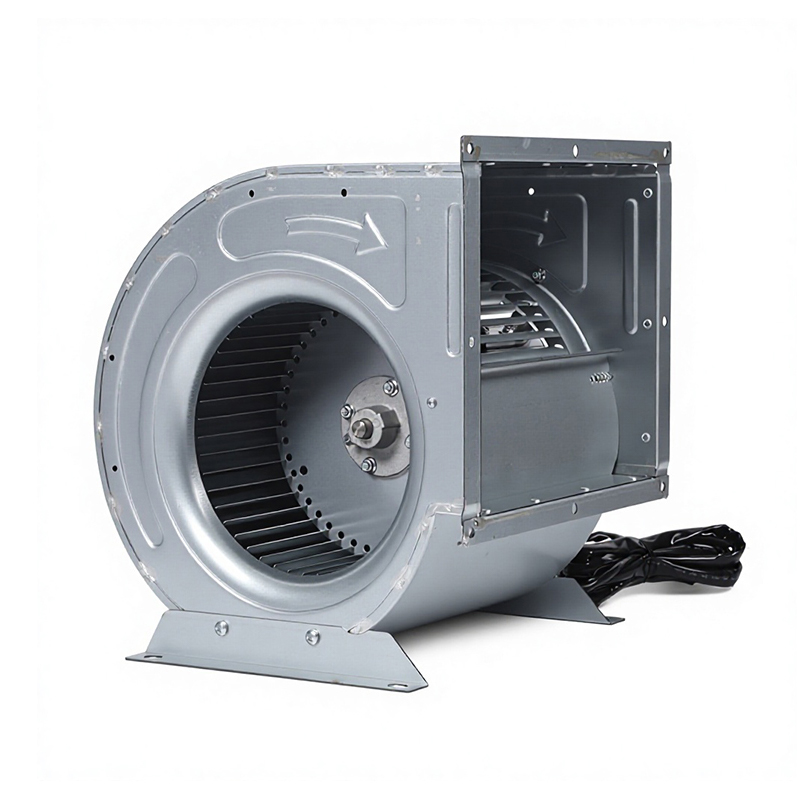 SYZ 9-9 Variable-Speed EC Centrifugal Fan for HVACWith 200–1100 RPM adjustment and a 1000 W direct-drive motor, this EC fan suits HVAC ventilation, air replacement, circulation, and fresh-air comfort.View Product →
Blower Impellers: The Component Buyers Often Leave Blank
The impeller is where efficiency, noise and balance come from, and it is the part most often left unspecified on a purchase order. IM series blower impellers cover single inlet, double inlet, multiblade and dual-spec shaft hole versions, usually formed from SGCC steel sheet.
- Wheel diameter and inlet width, matched to the housing you already have.
- Blade count and curvature, which decide the shape of the pressure curve.
- Rotation direction, because a backward-curved wheel fitted the wrong way loses most of its pressure.
- Shaft hole diameter and tolerance, since a loose fit shows up as vibration at full speed.
- Balancing and runout limits, agreed as a number rather than a feeling.
 IM 228-203 Dual-Inlet Plastic Blower ImpellerThis 228 mm × 203 mm dual-inlet impeller is useful when shaft fit matters: PP with 30% GF, 1/2-inch center hole, and customizable colors.View Product →
Two details prevent the most rework: rotation direction and shaft hole fit. Both are cheap to confirm at the drawing stage and expensive to correct after assembly.
Procurement Checklist Before You Place an Order
- Fix the duty point at the worst-case resistance in the cycle, not the clean-filter value.
- Add a working margin of 10-20% airflow, with a curve that still covers resistance at the end of filter life.
- Confirm the motor interface: AC tap speeds or EC control signal, plus the turndown the board needs.
- Check the mechanical interface: wheel diameter, inlet width, shaft hole, rotation direction and mounting plane.
- Agree on noise at the operating speed, measured the same way by both sides.
- Ask for the curve and running test evidence at the rated point before shipment.
FAQ
Is a centrifugal fan the same as a blower?
In everyday HVAC language, yes. Technically a blower is a fan that raises pressure enough to push air through significant resistance. A centrifugal blower is a fan with a wheel and a scroll housing; a positive displacement blower is a different machine.
Which is quieter, forward-curved or backward-curved?
Backward-curved wheels usually run quieter at the same duty point because they need fewer blades and turn more slowly for the same pressure. Forward-curved wheels can still be quiet in a well-designed scroll, but they reach their limit sooner as resistance rises.
How much airflow margin should I add?
For most HVAC equipment, 10-20% above the nominal requirement covers duct leakage, filter loading and manufacturing variation. Margin beyond that wastes motor power and raises noise.
Can I replace an AC blower with an EC one?
Usually yes, if the mounting footprint, wheel diameter and shaft match and the control board can supply a 0-10 V or PWM signal. Check the pressure curve first, because AC and EC versions of the same frame size do not always share the same duty point.
If you are specifying a fan for a new unit or replacing one that failed its airflow test, the fastest route is to send the duty point: airflow, static pressure, voltage, control signal and mounting dimensions. A supplier who answers with a fan curve instead of a price list is usually the one who can solve the problem.
Send your specification through the contact page and ask for the curve, the impeller drawing and the test data together.


 ENG
