
 English
 Español

Content
A 400 mm double-inlet blower is specified for an air handler that must move 2,700 CFM against 1.0 in. w.g. Two quotations come back: a forward curved impeller drawing about 500 W of shaft power, and a backward curved wheel doing the same duty at roughly 400 W. Both fit the same envelope, and neither is a drop-in replacement for the other.
The short answer: choose a forward curved impeller for high airflow at low static pressure, where first cost and a compact stamped wheel matter and the airstream is clean. Choose a backward curved impeller where efficiency, static pressure capability and part-load stability matter, or where the air carries dust, grease or lint. The sections below explain why that rule holds, and where it breaks.
Blade Geometry Is the Only Real Difference
Every other difference between the two wheels follows from one geometric choice: which way the blades lean relative to rotation. That choice sets the outlet velocity triangle, and the velocity triangle sets efficiency, pressure, noise and cost.
Forward curved (FC)
- Blades tilt in the direction of rotation, forming the familiar squirrel-cage wheel with many shallow blades, often 30 to 60 on small wheels.
- Air leaves tangentially, close to the direction of rotation, so outlet velocity is high and the volute must convert most of that kinetic energy into static pressure.
- Short, narrow passages move a lot of air at low pressure for a given wheel diameter.
- The power curve is overloading: shaft power keeps climbing with airflow, so motors are usually sized with margin.
Backward curved (BC)
- Blades lean against rotation. There are fewer of them, typically 8 to 16, and each is longer and deeper.
- Air leaves almost radially, and the blade passages act as a diffuser, recovering pressure inside the wheel rather than in the volute alone.
- The power curve is non-overloading: power peaks near mid-flow and falls away, which protects the motor if resistance drops.
- Longer blades concentrate stress on the disc, cone and hub, so the wheel needs heavier construction.
You cannot fit backward curved blades to a forward curved hub. Hub diameter, blade angle, inlet cone and volute throat are matched as a set, so a blade swap changes the flow coefficient, the duty point and the shaft power at once. Our note on what a blower impeller actually is covers the same geometry from the part side.
Pressure, Flow and the Shape of the Curve
The two impellers differ across the whole curve, not just at one point. A backward curved wheel produces a higher, steeper pressure curve that falls steadily with airflow; a forward curved wheel produces a lower, flatter curve with a stall dip at low flow and a sharp drop near free delivery.
Illustrative pressure-flow curve shapes for the same wheel diameter and speed; not test data. The backward curved curve is higher and steeper, the forward curved curve is lower and flatter.
Curve shape matters more than the single duty point printed on a submittal. A forward curved fan is usually selected with its duty point well out along the curve, often between 40 and 60 percent of free delivery, where the curve is flat. When system resistance rises, from a loaded filter or a longer duct run, a small pressure rise costs a large share of the airflow. The same change moves the steeper backward curved curve far less, and its non-overloading power curve means the motor does not have to be oversized to survive it.
| Parameter | Forward curved | Backward curved |
|---|---|---|
| Blade count, typical | 30 to 60 shallow blades | 8 to 16 deeper blades |
| Air exit direction | Tangential, with rotation | Radial |
| Peak static efficiency | 55 to 65 percent | 75 to 85 percent |
| Pressure capability | Low to medium | Medium to high |
| Power curve | Overloading | Non-overloading |
| Dust and grease | Narrow passages clog | Wider passages tolerate dirt |
| Noise at equal duty | Higher | Lower |
| Typical duties | Fan coils, VAV boxes, purifiers, dehumidifiers | Ducted AHUs, HEPA banks, kitchen extract |
Efficiency, Energy and Noise
Peak static efficiency is where the two types separate most clearly. A well-matched forward curved wheel typically peaks between 55 and 65 percent static efficiency. A backward curved wheel of comparable quality peaks between 75 and 85 percent.
Typical peak static efficiency. Bars show a typical value; the orange whiskers show the range seen across 100-450 mm direct-drive wheels.
A 10 to 20 point gap becomes roughly 15 to 25 percent lower shaft power at the same duty. Take a fan running 8,000 hours a year at 0.12 USD per kWh. At 500 W shaft power the forward curved unit consumes about 4,000 kWh a year; at 400 W the backward curved unit consumes about 3,200 kWh. That is roughly 800 kWh, or 96 USD, saved per fan per year, and close to 2,900 USD across thirty air handlers.
Noise follows the same geometry. Many narrow passages and a high outlet velocity make the forward curved wheel louder in broadband turbulence and stronger at blade-pass frequency. The backward curved wheel, with fewer and deeper blades, is generally quieter at equal airflow and pressure. In a small low-speed appliance, though, packaging and mounting often decide the result.
- Blade passage and incidence, 40%
- Volute and casing friction, 26%
- Inlet and recirculation, 22%
- Motor and drive losses, 12%
Illustrative split of losses in a compact direct-drive forward curved fan; indicative figures, not test data from one model.
Blade passage and incidence losses dominate that split, and they are exactly what the backward curved geometry attacks.
Dust, Temperature and Long-Term Reliability
In dirty airstreams the choice is usually made for you. Forward curved wheels have narrow blade passages, and on a 133 mm wheel the gap can be only a few millimetres, so grease, lint or fine dust bridges those gaps. The wheel then goes out of balance, vibration climbs and bearings fail early.
- Kitchen extract, welding fume and textile lint: specify backward curved.
- Filtered supply or return air: forward curved is fine and cheaper.
- Humid or condensing air: check wheel material and coating, not just blade angle.
- High ambient temperature: the motor and bearing limit usually arrives before the impeller limit.
Stress is the other long-term factor. A backward curved wheel needs a higher tip speed than an FC wheel of the same diameter to reach the same pressure, so its disc, cone and hub carry more load. A light-gauge backward curved wheel is a fatigue risk, not a bargain.
Matching the Impeller to Your Application
In practice the impeller type is chosen before the model number. Three duty families cover most of what we build.
Low pressure, high flow, compact: forward curved
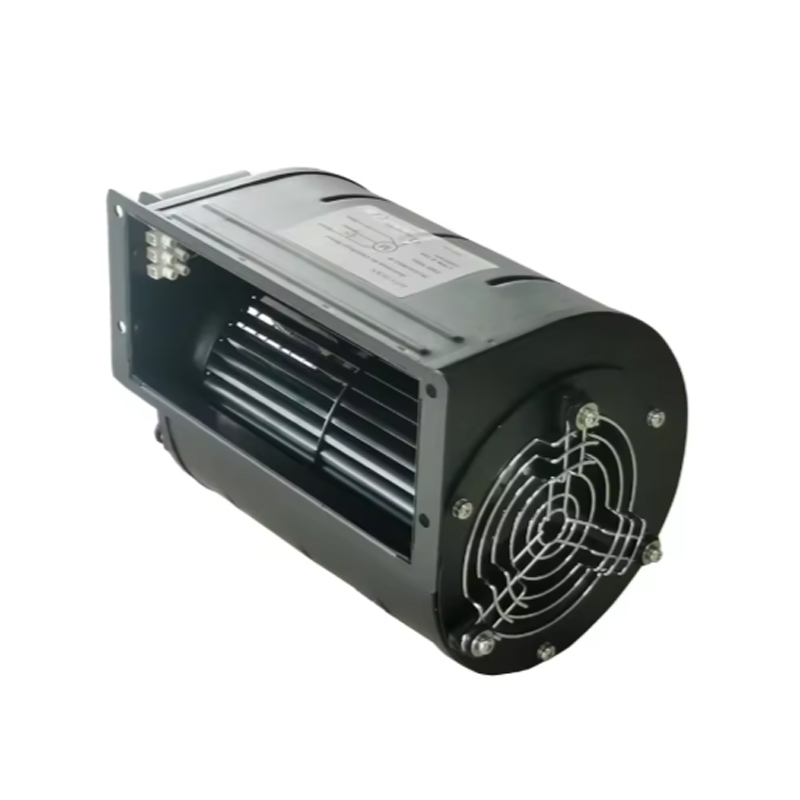
Fan coils, VAV terminal boxes, ducted split units, air purifiers and dehumidifiers all sit in the low-pressure band. Here a forward curved single-inlet or double-inlet wheel delivers the airflow from a smaller, lighter and cheaper wheel, and direct-drive construction keeps the assembly short.
 220v forward curved single inlet centrifugal fans1. Carefully designed dimensions ensure harmonious proportions across all components. The single-inlet design, combined with the forward-curved impeller, creates a mor...View Product →
Medium to high pressure: backward curved
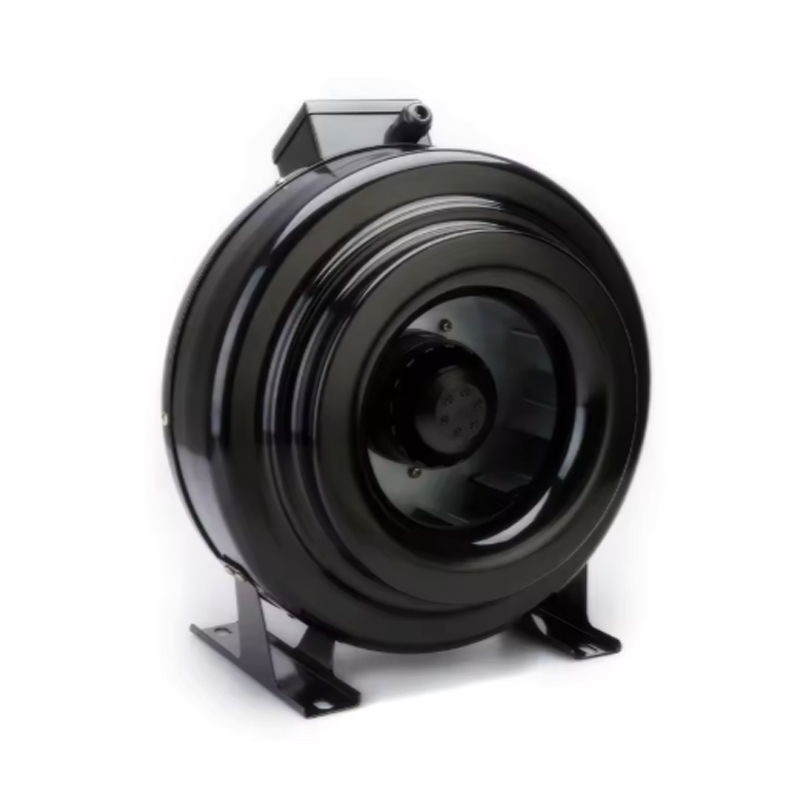
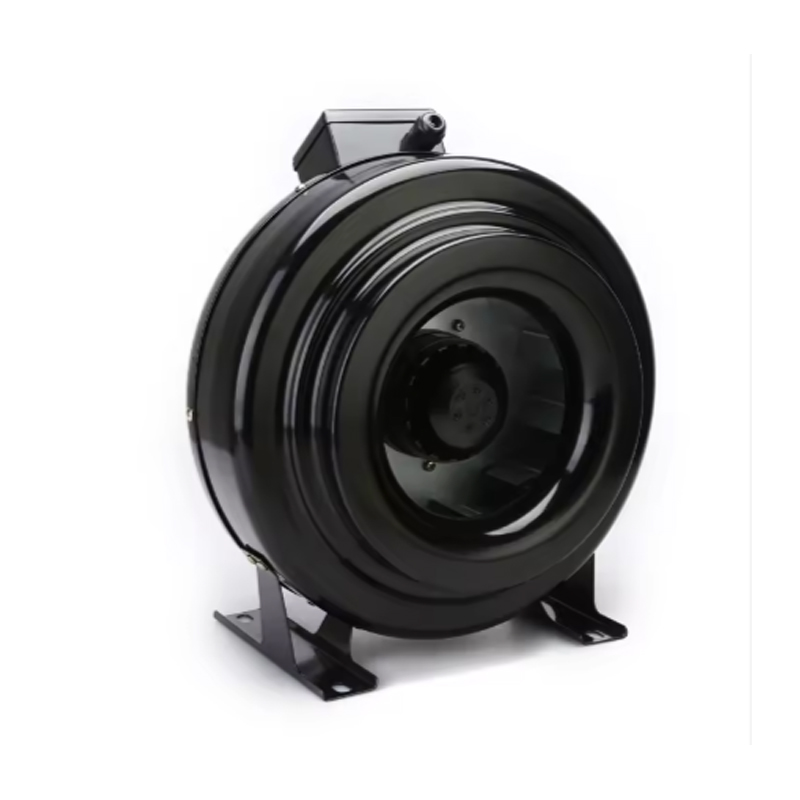
Ducted air handling units with long runs, HEPA and fine-filter banks, kitchen extract and process air push the duty point up the pressure axis. A backward curved wheel holds efficiency there and keeps power draw in check, even when the filters load up.
 220V inclined impeller duct backward centrifugal fans1. The black exterior offers a simple and elegant design, perfectly suited to any kitchen or plumbing installation environment. 2. The metal (galvanized steel) housing...View Product →
OEM wheels and replacement impellers
Equipment builders often buy the wheel rather than the fan. If you are designing your own housing, the geometry still has to match as a set, because hub diameter, blade angle, inlet cone and volute gap are chosen together and cannot be mixed freely.
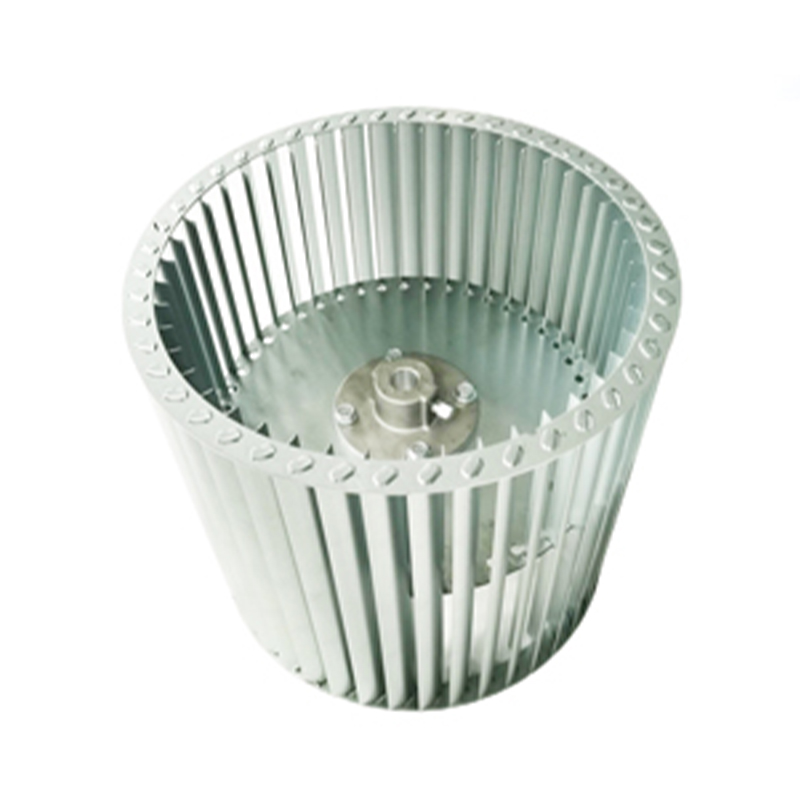 IM 260-240 double inlet multi-blade blower impeller1. Dimensions of 260mm in diameter and 240mm in height enable high-flow air delivery in confined spaces. 2. The impeller housing is constructed of galvanized steel, ad...View Product →
A Selection Checklist Before You Commit
Quotations for the two impeller types are not comparable until the duty point is fully specified. Ask for these seven items in writing:
- Airflow and static pressure at the real operating point, not at free delivery.
- The test standard and tolerance behind the published curve, for example plus or minus 5 percent on airflow.
- Supply voltage, motor type and speed control: AC, EC with 0-10V, or three-speed.
- Sound power level at the duty point, not a sound pressure figure measured at one metre.
- Maximum ambient temperature and airstream condition, including dust, grease or moisture.
- Envelope limits: wheel diameter, overall depth and flange geometry.
- Wheel material, balancing grade and expected bearing life.
Two procurement risks are worth naming. Comparing peak efficiency flatters whichever wheel peaks highest, even if neither will run there, so compare efficiency at the operating point instead. And treat a curve that was extrapolated rather than tested as a guess with a datasheet attached.
Frequently Asked Questions
Can I replace a forward curved impeller with a backward curved one in the same housing?
No. The volute throat, inlet cone and hub are matched to one velocity triangle. Swapping the wheel changes the flow coefficient, shifts the duty point and changes shaft power, usually enough to require a different motor and housing.
Which type handles dusty air better?
Backward curved, almost always. Fewer, deeper blades leave wider passages that resist clogging, and the non-overloading power curve is more forgiving when the airstream changes.
Is a backward curved fan always more efficient?
At a well-matched duty point, yes, typically by 10 to 20 percentage points of peak static efficiency. But peak efficiency is not the same as efficiency in service. A cheap backward curved wheel running far from its design point can lose to a well-matched forward curved unit, and it will cost more to buy.
Which one is quieter?
At equal airflow and pressure, the backward curved wheel is normally quieter because outlet velocity and blade-pass energy are lower. In small, low-speed appliances the gap is small enough that mounting and packaging often decide the noise result.
Choosing between a forward curved and a backward curved impeller is a choice about where you spend: on the wheel, or on electricity and maintenance. Compact, clean-air, low-pressure equipment stays with forward curved wheels. Higher-pressure, dustier or energy-sensitive duties move to backward curved, and the payback is usually measured in months rather than years.
Send us the duty point through the contact page with airflow, static pressure, voltage and ambient conditions, and we will come back with a wheel recommendation and a tested curve rather than a catalogue guess.
 ENG
