
 English
 Español
Content
- 1 Understanding Where Centrifugal Fan Noise Comes From
- 2 Optimize the Impeller and Volute Design
- 3 Install Inlet and Outlet Silencers
- 4 Mount on Vibration Isolators and Use Flexible Connectors
- 5 Control Fan Speed with a Variable Frequency Drive (VFD)
- 6 Optimize Duct Geometry to Reduce Turbulence
- 7 Apply Acoustic Treatment to the Fan Casing
- 8 Use Resonators at the Volute Cutoff
- 9 Maintenance Practices That Keep Noise Low
- 10 Noise Reduction Methods at a Glance
The most effective way to reduce centrifugal fan noise is to address it at the source: optimize the impeller-volute clearance, install inlet and outlet silencers, mount the fan on vibration isolators, and ensure the fan operates at its peak efficiency point. Combining these measures can realistically cut noise levels by 10–20 dB in most installations.
Understanding Where Centrifugal Fan Noise Comes From
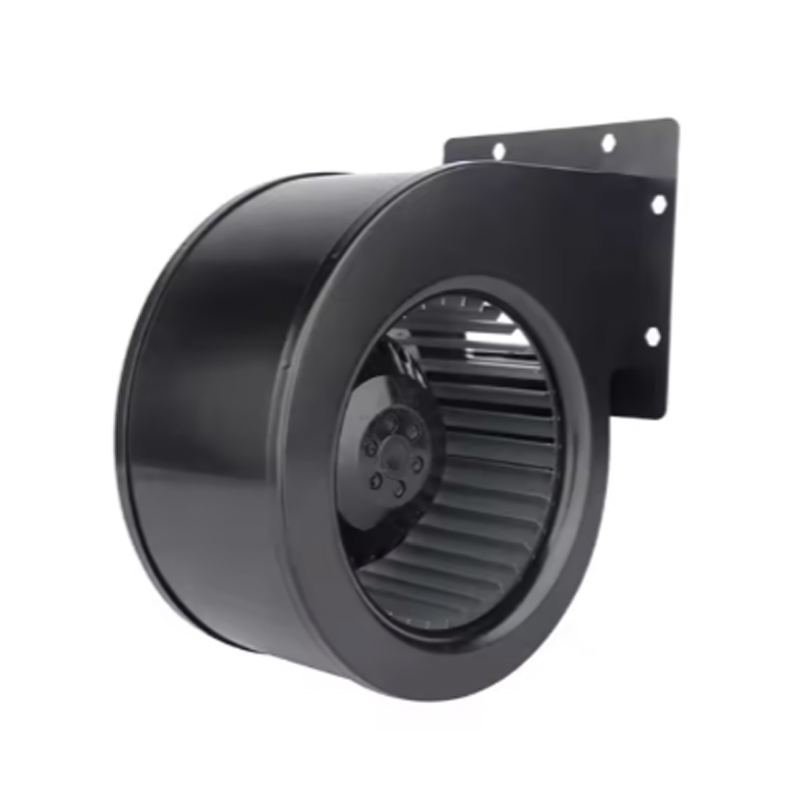
Before applying fixes, it helps to know what you are actually dealing with. Centrifugal fan noise has two distinct roots: aerodynamic noise and mechanical noise. The dominant aerodynamic source is the blade passing frequency (BPF) — the periodic pressure pulse generated each time an impeller blade sweeps past the volute tongue. Mechanical noise comes from motor bearings, belt drives, and structural vibration transmitted into the floor and ductwork.
| Noise Type | Primary Source | Typical Frequency Range | Recommended Control |
|---|---|---|---|
| Tonal (BPF) | Impeller–volute tongue interaction | 100 – 1,000 Hz | Increase cutoff clearance, resonators |
| Broadband aerodynamic | Turbulent flow, blade wakes | 500 Hz – 5 kHz | Inlet silencer, acoustically lined casing |
| Structural / vibration | Motor, bearings, imbalance | Below 500 Hz | Vibration isolators, flexible connectors |
| Duct-radiated | Pressure pulsations in ductwork | 50 – 500 Hz | Acoustic duct lining, sweeping bends |
Optimize the Impeller and Volute Design
The gap between the impeller tip and the volute tongue — known as cutoff clearance — is the single biggest design lever for tonal noise. Research shows that increasing this clearance directly lowers higher harmonics of the blade passing frequency. Complementary approaches include:
- Increase cutoff clearance — a larger gap between the impeller tip and the volute tongue reduces BPF tonal noise at the source.
- Use an acoustically optimized (soft) volute — replacing a hard-walled casing with an acoustically treated volute has been shown to substantially reduce overall noise across all operating conditions while reducing airflow by only 1–2%.
- Irregular blade spacing — distributing blades non-uniformly spreads the tonal energy across more frequencies, reducing the prominence of any single tone.
- Bionic volute tongue profiles — wave-leading-edge structures inspired by humpback whale fins can suppress leading-edge vortex shedding. Studies report a noise reduction of about 0.6 dB alongside a 5% increase in static pressure recovery.
- Backward-curved impeller blades — generally quieter and more efficient than radial or forward-curved blades at equivalent duty points.
Install Inlet and Outlet Silencers
A significant share of centrifugal fan noise exits through the inlet and discharge openings. Fitting dissipative or absorptive duct silencers at both points is one of the most cost-effective retrofit measures available.
Key installation rules to follow:
- Do not place a rectangular silencer hard against the fan discharge — place a spacer between them and rotate the splitter by 90° to avoid amplifying turbulence noise.
- Absorptive duct liners should be at least 3 times the duct diameter in length to achieve meaningful attenuation across the relevant frequency range.
- Select silencer type (cylindrical, rectangular, elbow) based on available space and the specific noise spectrum measured at the fan.
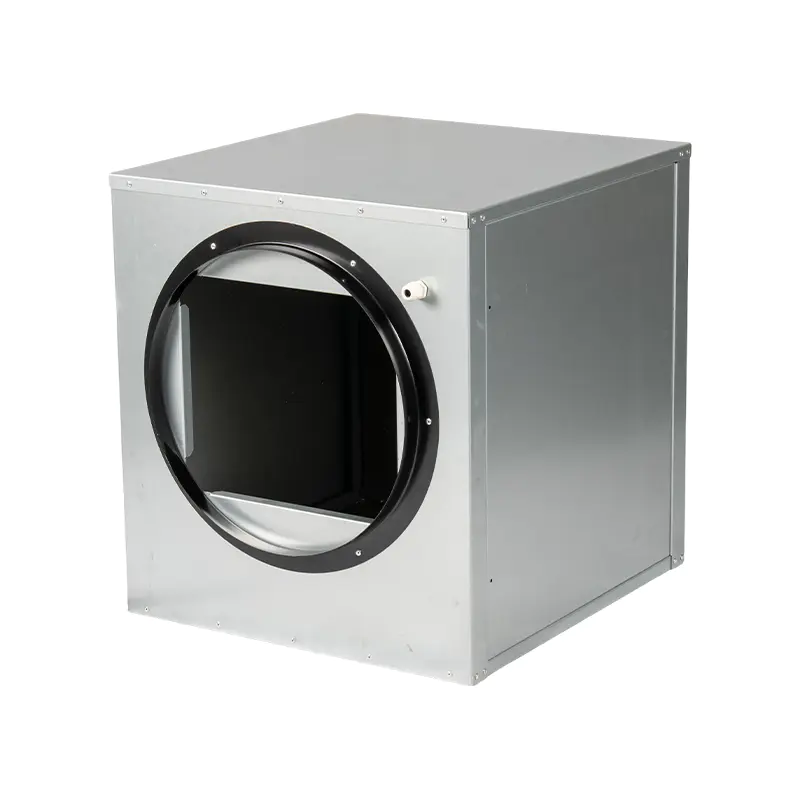
- Inlet box silencers in either straight or elbow configurations are available for close-coupling directly to the fan inlet, minimizing pressure loss.
Mount on Vibration Isolators and Use Flexible Connectors
Mechanical vibration from the rotating assembly travels through rigid ductwork and concrete flooring, re-radiating as low-frequency noise throughout a building. Physical isolation breaks this transmission path.
- Spring isolators or rubber-in-shear mounts beneath the fan base absorb dynamic energy before it reaches the structure. Spring mounts must be correctly sized for the combined weight of the fan, motor, and any attached ductwork — overloading spring mounts is a common installation error.
- Flexible canvas or rubber expansion joints between the fan flanges and the rigid duct prevent structural vibrations from echoing through the entire ventilation network.
- Anti-vibration hangers for suspended ductwork should use neoprene-coated or galvanized springs to resist corrosion in humid environments.
Control Fan Speed with a Variable Frequency Drive (VFD)
Fan noise scales steeply with rotational speed. Controlling the fan with a Variable Frequency Drive typically delivers around 5 dBA of noise reduction for every 20% reduction in fan speed. Because many systems are oversized for their actual duty, a VFD can run the fan closer to the optimal efficiency point — simultaneously reducing noise, energy consumption, and wear.
Always select a centrifugal fan whose nominal duty point sits at or near the peak of its efficiency curve. Running an oversized fan at partial load creates excess turbulence that adds unnecessary noise.
Optimize Duct Geometry to Reduce Turbulence
Aerodynamic noise caused by turbulent airflow is a major contributor to overall system noise. Poor duct geometry — sharp bends close to the fan, abrupt takeoffs, or obstructions at the inlet — forces the fan to work against uneven flow, generating a loud low-frequency rumble.
- Replace sharp 90° bends with sweeping radius bends to allow air to enter and exit the fan smoothly.
- Allow adequate straight duct run before and after the fan — ideally 3–5 duct diameters of straight section on both sides.
- Avoid placing duct bends immediately downstream of the discharge; turbulence generated there travels back into the fan housing.
- Size ducts to keep air velocities within the recommended range — typically 5–10 m/s in main branches — to minimize velocity-related noise.
Apply Acoustic Treatment to the Fan Casing
Sound radiated directly from the vibrating fan housing contributes to the total noise field around the unit. Two complementary approaches are effective:
- Anti-noise damping coatings applied to the outer surface of the casing absorb vibrational energy and reduce noise radiation. Increasing casing wall thickness has a similar damping effect.
- Acoustic enclosures built around the complete fan assembly contain and absorb broadband noise before it propagates into the surrounding space. Enclosures must include ventilation provisions to prevent heat buildup.
- Seal any gaps around shaft penetrations — clearances around rotating shafts are a common escape path for high-frequency noise that is disproportionately annoying.
Use Resonators at the Volute Cutoff
For installations where tonal BPF noise is the primary complaint, tuned resonators mounted at the cutoff of the centrifugal fan offer a highly efficient and simple solution. The resonator cavity length is calculated from the quarter-wave formula L = c / 4f, where c is the speed of sound and f is the blade passing frequency. Acoustic baffles tested in commercial refrigeration applications achieved blade passage tone reductions of 17–19 dB at target frequencies — a dramatic improvement from a passive device with no moving parts.
Maintenance Practices That Keep Noise Low
Even a well-designed, correctly installed fan becomes noisy if maintenance is neglected. The following checks should be part of any routine service schedule:
- Inspect and rebalance the impeller if vibration levels increase — blade erosion and deposits create imbalance that drives up both vibration and noise.
- Lubricate or replace bearings on schedule; worn bearings are a leading cause of high-frequency whining and eventual structural failure.
- Check belt drives for tension and alignment — a misaligned or loose belt creates significant mechanical noise and shortens belt life.
- Inspect flexible connectors for cracks or stiffening; a rigid flexible connector defeats the entire isolation system.
- Clean inlet screens and filters regularly — blockages force the fan to operate off its design curve, increasing both noise and energy consumption.
Noise Reduction Methods at a Glance
| Method | Typical Noise Reduction | Best For | Retrofit Possible |
|---|---|---|---|
| Inlet / outlet silencers | 5 – 15 dB | Broadband and tonal noise | Yes |
| Vibration isolators | 3 – 10 dB (structural) | Low-frequency structure-borne noise | Yes |
| Variable Frequency Drive | ~5 dBA per 20% speed reduction | Oversized or variable-load systems | Yes |
| Increased cutoff clearance | 2 – 6 dB | BPF tonal reduction | Design stage preferred |
| Acoustically lined casing | 3 – 8 dB | Broadband housing radiation | Yes (coating) |
| Resonators at cutoff | Up to 17 – 19 dB | Dominant single-tone BPF noise | Yes |
| Acoustic enclosure | 10 – 25 dB | High-noise environments | Yes |
 ENG
ENG
