What are the effects of rotational speed on airflow and noise in AC centrifugal fans?
The key role of AC centrifugal fans in industrial automation, HVAC, and electrical equipment:
1. Rotational speed determines airflow (linear relationship): Under the same airflow resistance, airflow Q is basically directly proportional to rotational speed N, Q∝N.
During design, a suitable rotational speed is often selected to meet the system's airflow requirements; if the rotational speed is too low, the airflow is insufficient, leading to inadequate heat dissipation or ventilation.
2. Nonlinear amplification of noise by rotational speed:
Sound power L increases with the 4.8th power of rotational speed; doubling the rotational speed can increase noise by approximately 27 times.
At high rotational speeds, eddy current noise becomes dominant, with frequencies concentrated in the 500Hz–2kHz range; at low rotational speeds, rotational noise is dominant.
3. Noise and airflow balancing strategies: Using variable frequency drive (VFD) to achieve precise rotational speed control can meet the required airflow while keeping noise within design limits.
Ningbo Haoyue Fan Manufacturing Co., Ltd.'s direct-drive AC/EC motors inherently support stepless speed regulation, facilitating the aforementioned balance.
What are the differences between AC Centrifugal Fans and ordinary centrifugal fans?
1. Drive Method:
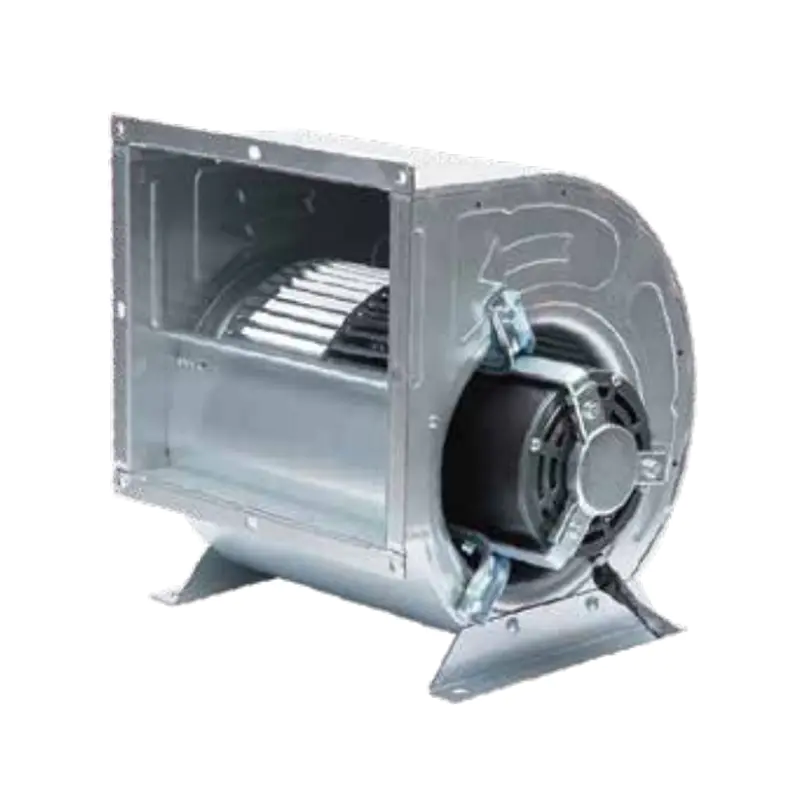
AC Centrifugal Fans: Use single-phase direct-coupled AC or EC motors, with a compact structure, no belt drive, and fast speed response.
Ordinary centrifugal fans: Mostly use belt or gear drives, speed regulation is mechanically limited, and their size is relatively large.
2. Efficiency and Noise Level: Utilizing high-efficiency impellers and optimized airflow design, ACCentrifugal Fans can achieve a specific sound power level as low as 24dB at the optimal operating point, resulting in lower noise.
Ordinary centrifugal fans, due to their simple structure and less optimized blade shape, typically have a higher noise-to-power ratio.
3. Speed Regulation and Control
ACCentrifugal Fans are equipped with variable frequency speed control or stepless speed regulation of EC motors, enabling real-time closed-loop control of airflow, pressure, and noise.
Ordinary centrifugal fans mostly rely on fixed speeds or manual valve adjustment, lacking sufficient speed regulation flexibility.
4. Application Scenarios
ACCentrifugal Fans: Suitable for VAV (Variable Air Volume) air conditioning, precision fresh air systems, and industrial facilities with high noise and energy efficiency requirements.
Ordinary centrifugal fans: Commonly used in ventilation or exhaust applications with high air pressure requirements and cost sensitivity.
|
AC Centrifugal Fans |
Conventional Centrifugal Fans |
| Drive Method |
Single‑phase direct‑coupled AC or EC motor, eliminating belts, resulting in lower noise |
Traditional AC induction motor or belt‑driven system |
| Energy Efficiency & Environmental Impact |
Advanced high‑efficiency impeller and control system; higher energy efficiency and lower operating cost |
Meets general industrial standards; moderate energy‑saving performance |
| Maintenance & Reliability |
Compact structure, premium materials, longer maintenance intervals, high reliability |
Higher maintenance frequency; lifespan depends on material and assembly quality |
| Typical Applications |
Variable‑air‑volume (VAV) air‑conditioning, VAV systems, precision HVAC, clean rooms, and other scenarios demanding high efficiency and low noise |
General ventilation, exhaust, low‑pressure industrial or commercial ventilation systems |
| Speed Control |
Electronic speed control or variable‑frequency drive (VFD) for precise airflow/pressure regulation |
Mostly fixed speed or mechanical speed control with limited adjustment range |
How to determine if AC Centrifugal Fans have electrical system problems?
1. Common Electrical Fault Types
Motor Overload: Excessive load or abnormal speed leads to increased current and significant temperature rise.
Insulation Damage: Insulation aging in humid or high-temperature environments causes leakage or short circuits.
Control System Failure: Malfunction of the inverter, contactor, or protective relay leads to abnormal start/stop.
2. Key Points for On-site Inspection
Current/Voltage Monitoring: Use a multimeter or power analyzer to verify that the operating current is within the rated range.
Temperature Monitoring: If the motor casing temperature exceeds the rated value by more than 10℃, check the heat dissipation or load conditions.
Direction and Start Signal: Confirm that the motor wiring is correct and the phase sequence is accurate to prevent impeller reversal from causing mechanical shock (refer to the method for determining forward and reverse rotation).
3. Fault Diagnosis Process (Simplified Version)
① Visual Inspection: Check for cracks, corrosion, and dust accumulation on the casing; check for loose terminals.
② Electrical Testing: Measure the insulation resistance (≥1MΩ is acceptable), and check the grounding.
③ Operation Monitoring: Record the peak starting current and the waveform of the operating current. If abnormal fluctuations occur, further check the inverter parameters or the motor itself.
4. Maintenance and Prevention Recommendations
Regularly clean the fan inlet and outlet to prevent dust from causing poor motor heat dissipation.
Using variable frequency speed control can reduce the starting inrush current and extend the motor's lifespan.
We recommend using the direct-coupled AC/EC motor provided by Ningbo Haoyue, which integrates overload protection and temperature monitoring, facilitating intelligent fault early warning.
Frequently Asked Questions (FAQ)
Q1: What are the main models and specifications of centrifugal fans from Ningbo Haoyue Fan Manufacturing Co., Ltd.?
A: The company offers multiple series of centrifugal fans, such as HTFC-I, YDF-A/B, and 4-72, with air volumes ranging from approximately 400 m³/h to 40,000 m³/h, air pressures from 100 Pa to 800 Pa, and power from 0.5 kW to 5 kW. Specific models and technical parameters can be found in the product catalog.
Q2: What are the core advantages of centrifugal fans?
A: High efficiency, low noise, compact structure, and convenient speed adjustment. They can deliver large air volumes in confined spaces, making them particularly suitable for variable air volume (VAV) air conditioning and ducted air conditioning systems.
Q3: Which air conditioning or ventilation systems are these centrifugal fans suitable for?
A: Suitable for various HVAC scenarios, including VAV air conditioning units, ducted air conditioning units, HVACR systems, fresh air systems, and air purification equipment.
Q4: What motor drive options does the company offer?
A: We offer two drive structures: single-phase direct-drive AC motors and brushless DC (EC) motors. You can choose the appropriate motor type based on your needs.

 English
 Español

 ENG
ENG
