
 English
 Español
Content
Suppose you are sizing the blower for a ducted air-conditioning unit. The project owner asks for variable airflow, the energy manager asks for low running cost, and the maintenance team asks for a component that will not need attention every month. One unit answers all three: an EC centrifugal blower. Its integrated controller adjusts speed without an external frequency inverter, and its brushless motor holds high efficiency across a wide operating range. This guide explains how EC centrifugal blowers work, where they save energy, and how to specify one with confidence.
What Is an EC Centrifugal Blower?
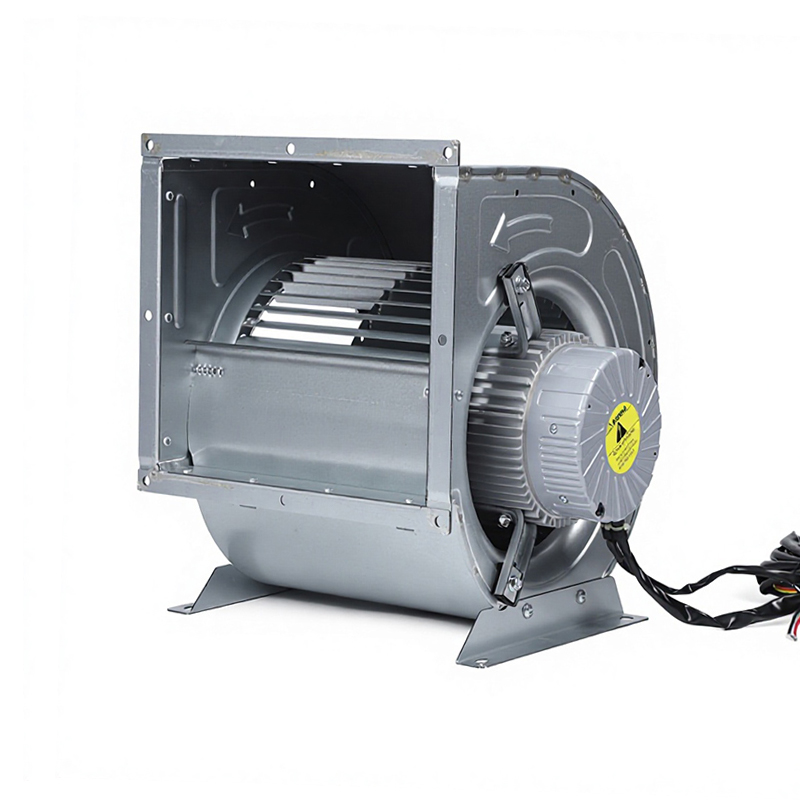
An EC centrifugal blower is a centrifugal fan driven by an electronically commutated (EC) motor. "EC" means the motor is a brushless DC machine whose stator windings are switched electronically rather than through carbon brushes. Because the commutation electronics live inside the motor housing, the complete blower — impeller, motor, and controller — arrives as a single, compact unit.
Key components
- Impeller: forward-curved or backward-curved blades that transfer energy to the air.
- Volute housing: the scroll-shaped casing that collects discharged air and converts velocity into static pressure.
- EC motor: a permanent-magnet rotor, stator windings, and an integrated inverter stage.
- Control connection: a 0-10 V DC, PWM, or potentiometer input that sets the target speed.
A conventional AC centrifugal blower is tied to the mains frequency, so a two-pole induction motor runs at roughly 2,800-2,900 rpm regardless of load. An EC blower, by contrast, can be commanded across a wide speed range while maintaining near-constant motor efficiency. For a broader introduction to the technology, read our explainer on what EC centrifugal fans are before you compare datasheets.
How an EC Centrifugal Blower Works
The airflow path is the same as any centrifugal machine. Air enters the impeller eye in the axial direction, the blades accelerate it radially, and the volute collects the high-velocity air, slowing it down to convert kinetic energy into static pressure. That static pressure pushes the air through ducts, coils, and filters.
The EC motor changes how rotation is produced. The integrated controller first rectifies the incoming AC supply to DC, then energises the stator windings in sequence so the permanent-magnet rotor follows a rotating magnetic field. Rotor position is sensed by Hall sensors or by back-EMF detection, which lets the controller maintain torque at any speed without mechanical brushes.
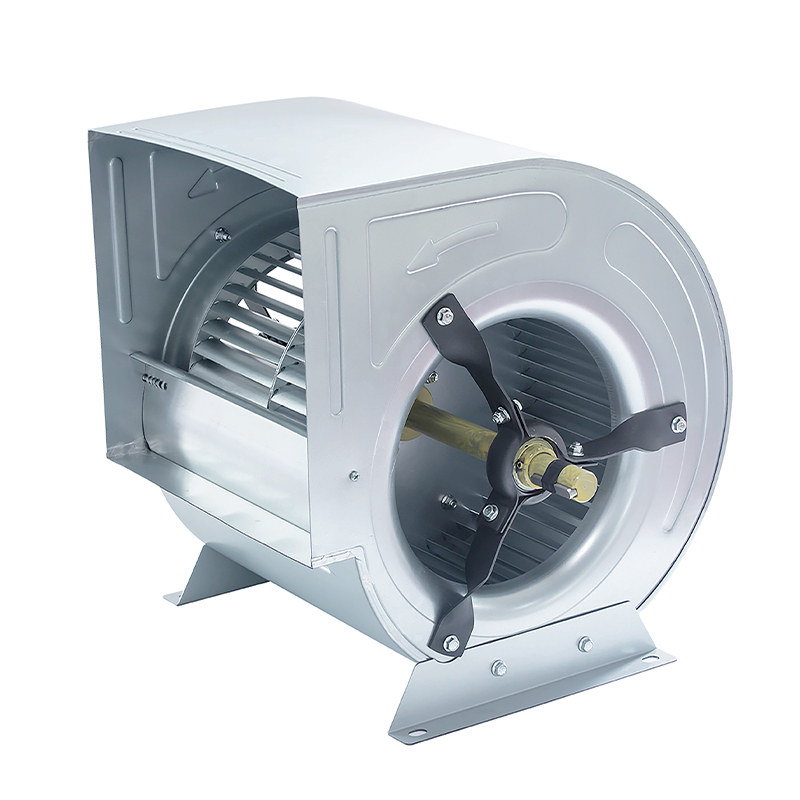
Speed control is therefore a signal, not a mechanical adjustment. A building management system can send 0-10 V DC, or the fan can be driven by PWM. As an example, the SYZ-77 0-10 V speed-control EC centrifugal fan accepts a 0-10 V input, making it simple to ramp airflow according to temperature or CO2 demand.
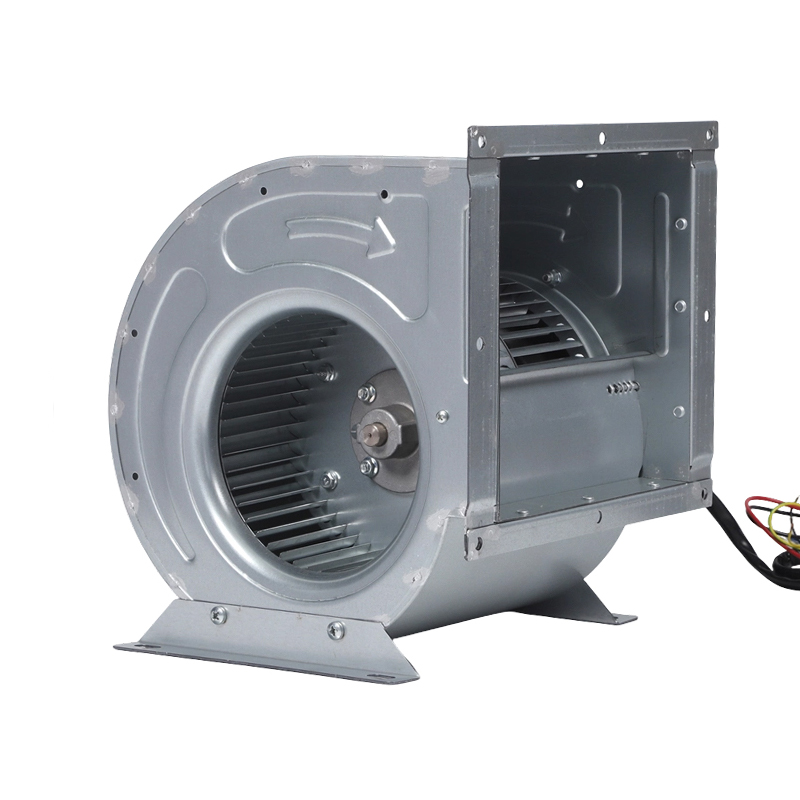 Syz 7-7 0-10v Speed Control Ec Centrifugal Fans Supplier, Custom Factory - YuyaoYuyao Jiale Ventilation Equipment Co., Ltd is China OEM SYZ 7-7 0-10V Speed Control EC centrifugal fans supplier and factory, we speciali...View Product →
Energy Efficiency and Other Benefits
Energy savings under real operating conditions
At full speed, an EC motor and a good AC induction motor are not far apart. The difference appears at partial load. Fan affinity laws state that power changes with the cube of speed: a blower running at 80% speed draws only about half the power of one running at full speed. An EC blower follows this law because the motor itself slows the impeller. An AC blower with an outlet damper or inlet vane does not; the motor keeps drawing high current while the damper wastes the pressure. That is why EC centrifugal blowers commonly save 30-50% of energy in variable-load equipment.
Quieter operation
Because the impeller runs slower at part load, airflow noise decreases together with speed. Electronic commutation also removes the slip and magnetic hum that are typical of induction motors running at reduced voltage.
Compact and controllable
No external frequency inverter, no V-belt, and no separate motor starter are required. The EC blower is a self-contained package that fits inside fan-coil units, air handling units, and compact fresh-air machines.
| Item | AC Centrifugal Blower | EC Centrifugal Blower |
|---|---|---|
| Speed control | Fixed or multi-tap | Continuous 0-10 V / PWM |
| Partial-load power | Remains high | Drops with the fan law |
| External drive | Not required | Not required |
| Building management link | Usually no | 0-10 V, PWM, Modbus |
| Maintenance | No brushes, but winding ageing | No brushes, fewer wearing parts |
| Upfront cost | Lower | Higher, paid back by savings |
Longer service life
Without brushes and with better thermal management, the EC motor removes the two most common failure points of small motors. Bearing quality usually decides the service life of the blower, and that is driven by the manufacturer's bearing selection and assembly control.
How to Select an EC Centrifugal Blower
Define the duty point first
Every blower has an airflow-static pressure curve. You need one that delivers the required airflow at the required static pressure, with a margin for dirty filters and duct tolerances. If the duty point sits near the right edge of the curve, a small change in resistance can stall the blower or drop airflow sharply.
Forward-curved or backward-curved?
Forward-curved impellers produce more airflow for a given diameter and stay compact, which makes them common in fan-coil units. Backward-curved blades handle higher static pressure and keep efficiency stable at partial load. The table below summarises the difference.
| Feature | Forward-Curved Impeller | Backward-Curved Impeller |
|---|---|---|
| Airflow at the same diameter | Higher | Lower |
| Static pressure capability | Low to medium | Medium to high |
| Part-load efficiency | Moderate | Better |
| Typical duty | Fan coils, small ducts, AHUs | High-resistance ducts and filters |
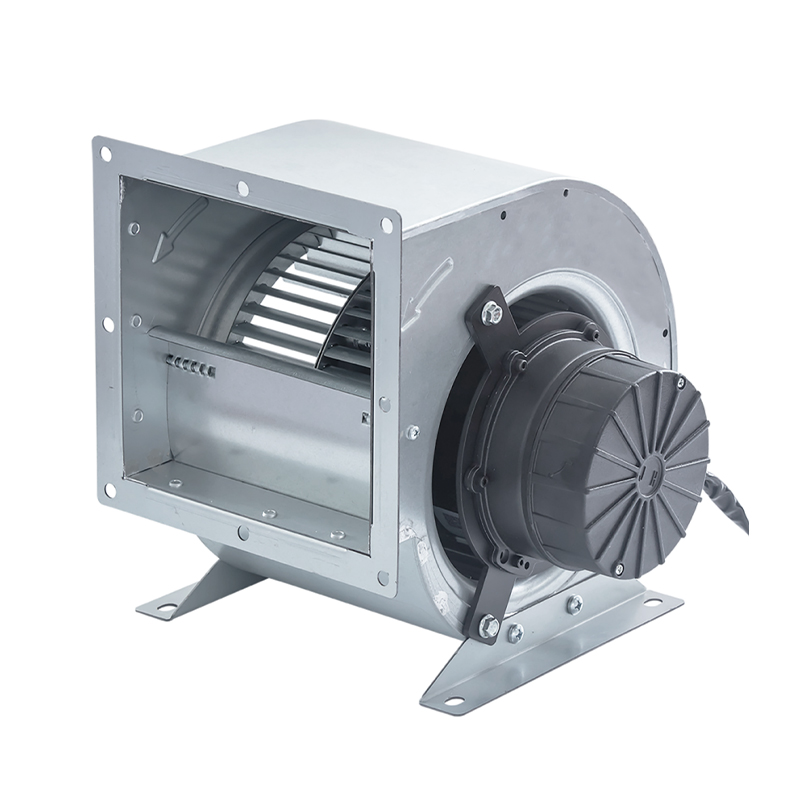
For high-volume duties at moderate static pressure, a large radial wheel such as the SYZ-1010 large-airflow radial EC centrifugal blower gives a practical balance of airflow and motor size. For compact equipment, small forward-curved wheels keep the package short.
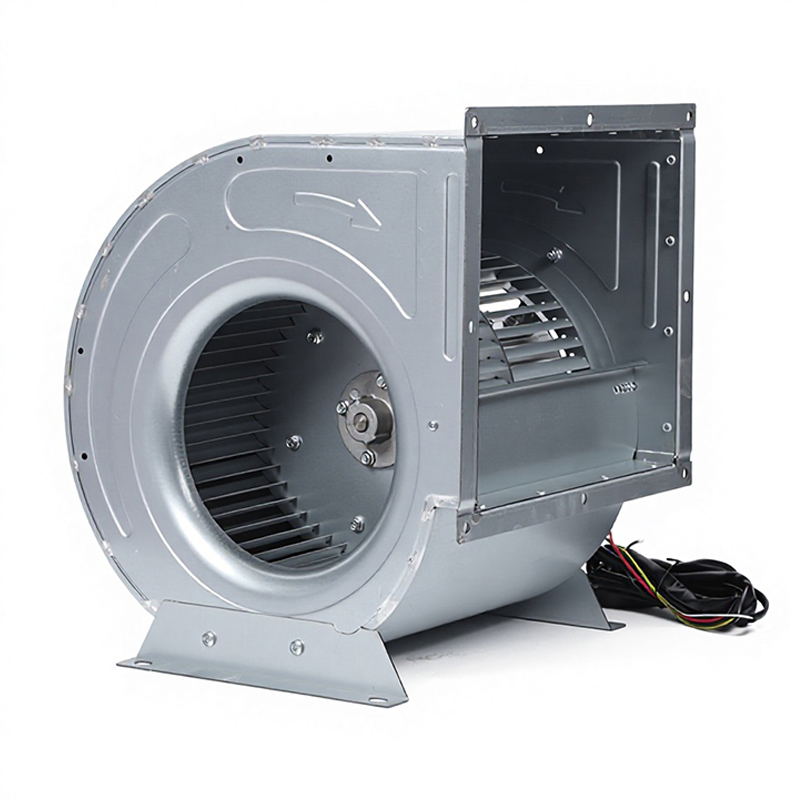 High Speed Blower Fan Supplier, OEM High Speed Blower Fan CompanyYuyao Jiale Ventilation is China OEM high speed blower fan supplier and high speed blower fan company, we specialize in custom large airf...View Product →
Choose the control interface early
0-10 V is the most common input in HVAC; PWM suits microcontroller-driven products; Modbus or other serial links may be needed for building networks. Confirm that the manufacturer offers the interface your control board or BMS expects.
Check the supplier's production capability
EC blowers combine mechanical and electronic parts, so verify that the manufacturer has a documented test process for airflow, vibration, and electrical safety. This matters more than the brochure efficiency figure.
Common Applications of EC Centrifugal Blowers
The most visible application is HVAC air handling, where units vary airflow to match heating and cooling demand, so the EC blower pays for itself quickly. In fresh air ventilation, 0-10 V control keeps CO2 levels stable. In air purifiers and cleanroom equipment, low-speed operation at night and a small footprint are the deciding factors.
- HVAC & air handling 35%
- Fresh air ventilation 25%
- Air purification 20%
- Refrigeration & heat pumps 12%
- Telecom & data centers 8%
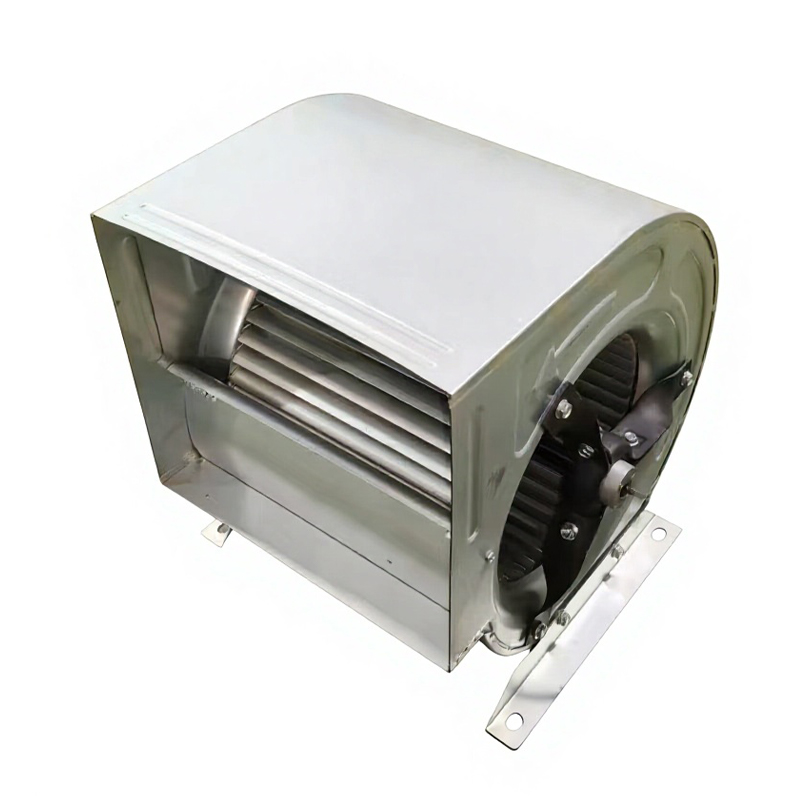
From refrigeration cabinets to telecom outdoor enclosures, the pattern is the same: an application with varying airflow demand benefits immediately. In HVAC air handling units, the SYZ-99 variable-speed EC centrifugal fan for HVAC equipment is a straightforward fit because its control inputs are designed for building automation. For other sizes and pressure classes, browse the full EC centrifugal fan product range and compare the performance curves.
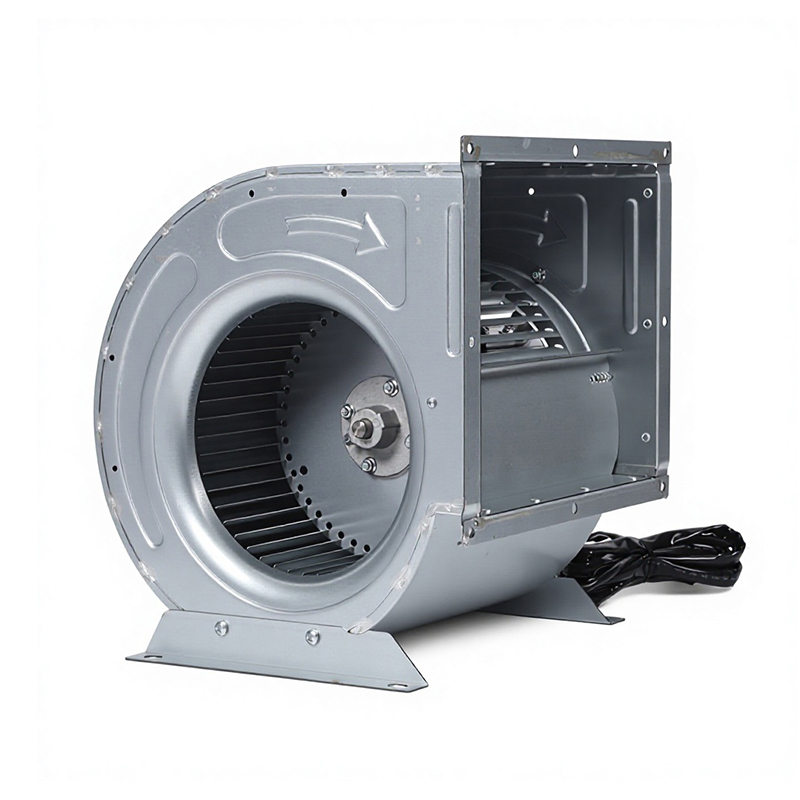 Custom HVAC Variable Speeds EC Centrifugal Fans Supplier, OEM CompanyYuyao Jiale Ventilation is China OEM HVAC variable speeds EC centrifugal fans supplier and company, we specialize in custom variable spee...View Product →
Frequently Asked Questions
What does "EC" mean in an EC centrifugal blower?
EC stands for electronically commutated. It describes a brushless DC motor that switches its stator windings electronically instead of using mechanical brushes, which reduces wear and improves efficiency across the speed range.
Do EC centrifugal blowers need a separate frequency inverter?
No. The controller is integrated into the motor. You supply standard AC mains, for example 230 V / 50 Hz, and an optional 0-10 V or PWM speed signal.
How much energy can an EC blower save compared with an AC blower?
In a variable-load application, a typical saving is 30-50% depending on the operating profile. At 40% airflow, an EC blower can draw roughly half the power of a damper-controlled AC blower.
Are EC centrifugal blowers quiet?
Generally yes, especially at reduced speed, because both blade speed and motor hum decrease. Final noise still depends on the volute design and the surrounding system.
What control signals are supported?
The most common are 0-10 V DC and PWM, with potentiometer control on some models. Selected series also accept Modbus RTU for building management integration.
The EC centrifugal blower has moved from a niche premium option to the default answer for equipment makers that need efficiency, controllability, and compactness in one part. Start from the airflow and static pressure your system actually requires, compare impeller types, and confirm the control interface. For variable-load HVAC, fresh air, and purification equipment, the small price premium of EC technology usually pays back within the first two to three years of continuous service.
 ENG
ENG
